Showing posts with label travel. Show all posts

Monday, February 8, 2016

Celebrating Our Family's 12th Anniversary In Virginia

Sao family, circa late summer 2004. 
On this date 12 years ago, Feb. 8, 2004, we arrived on the eastern outskirts of Nashville, Tenn., a family of 11 journeying across the U.S. via Interstate 40. Several days before we had bid our goodbyes to the West Coast and pointed our packed 12-passenger van east, leaving behind my beloved Oregon -- where I gladly spent my first 35 years -- to stake our claim in Gloucester, Va. We had first traveled south to Disneyland and after a long, glorious day in the happiest place on earth we were hitting the road.

I have a few distinct memories of our trip across the country. Beginning with Los Angeles traffic. We made it as far as Barstow, Calif., that first night. Not quite Williams, Ariz., my planned destination thanks to a -- surprise! -- clogged freeway heading out of LA. The next day, Feb. 6, 2004, dawned clear and cold. Evie would celebrate her 7th birthday in three states that day. On Feb. 7, 2004, MerriGrace would throw up in three states.

From Barstow we made it to Albuquerque, N.M. I remember swimming in an indoor/outdoor pool at our motel and Brenton becoming a human scab after an unfortunate incident on a fitness room treadmill. Next stop, Henryetta, Okla., where we stayed in a motel that I do believe had the worst "breakfast" I've ever had in my life. I also remember nearly freezing to death unpacking the van that night as an Arctic wind howled down off the Great Plains.

As we headed to Nashville 12 years ago today, we stopped for gas in a little outpost off the freeway in Arkansas. Somehow I avoided becoming a human ice cube filling up the van and ducked inside the convenience store for supplies and food stuffs. While waiting in line, a man struck up a conversation with me. I had no idea what he was saying and apologized before asking him what he said. We went back and forth about two or three times before I figured out that in backwoods country Arkansas, the word "wind" has three syllables. Maybe four. He was talking about the cold wind.

We would make it eventually, well technically the next day, to Gloucester, Va., where we hunkered down in two rooms at the Comfort Inn, right next door to the Winn-Dixie. RIP Gloucester Winn-Dixie, a death caused by the opening of the nearby Wal-Mart Supercenter. There were still people living in the Comfort Inn who were waiting for their houses to get patched up from getting bushwhacked by Hurricane Isabel, five months after she had barreled through the county. And every morning at the continental breakfast we were greeted by grandmotherly Miss Bernice.

The kids remember playing in the snow in the woods out back of the motel. I remember hearing tree frogs hollering from the woods one day and thinking we were under attack. We got turned down three or four times for rentals, always with the same story: Either the well or septic system, or both, would in no way, shape, or form handle the volumes a family of 11 would surely consume and produce. Never mind that even with a bunch more kids since then we would never have a water or septic system problem in all the years of living here.

We spent a fortnight plus one in the Comfort Inn before we found temporary housing until our house in Oregon sold. We were able to close on a place of our own in the woods a stone's throw from Burkes Mill Pond. We've moved around plenty since we've been here. From Mill Pond Road to a new home on Ark Road, where out back of the house and a football field away, down by a mountainous gum tree, a stream trickled right out of the side of a hill.

Then it was on to a big house in a new subdivision off of Belroi Road ,where one night a micro-burst -- that's weatherman talk for a mini-twister -- dropped a neighbor's tree in our yard. It narrowly missed our house but it pitched a limb from the tree right through our bedroom window, prompting an unexpected tumult that was like a shotgun blast for an alarm clock. This was at midnight and I've never seen Julie move so fast. To this day I'm positive I heard the sound of a train right before that limb tore through our window. Mind you, there's no trains in Gloucester.

From there we moved down the county to a Marshall Lane rancher in a peaceful neighborhood at the Point. It's where my kids walk a few blocks to the beach and fish minnows and little blue crabs out of a salty York River inlet not far from where the big rivah eases gently into Cheseapeake Bay.

We've had a grand time here in Gloucester. It's the only place where I've been asked more than once if I'm a Yankee. That makes me laugh. I usually answer that Oregon didn't become a state until 1859 and thanks to its relative newness, a general lack of a supply of able-bodied men and its great distance from the action in Virginia and elsewhere on the bloody Southern battlefields, the War of Northern Aggression wasn't really our scrap. Truth be told, however, I guess I am a Yankee seeing as how I count Ethan Allen of Vermont's Green Mountain Boys fame as an ancestor. But let's just keep that between us.

I usually greet people with a lively, "Howdy," something I trace back to my roots east of Oregon's splendid Cascade Mountains range. I guess people aren't used to my Oregon howdy because sometimes I have people respond, "Ah'm fah-ahn thanks, how're y'all doin'?" I've been asked about my accent, even though I've never known an Oregonian, not even those out east in John Day, Burns, or heck, metropolitan Fossil, to have one. I've been introduced to okra and collard greens, the glories of Chesapeake Bay, country ham biscuits and the best rivah sunsets in all of Virginia. Or anywhere for that matter.

I admit it. There's things I miss about Oregon. That meadow between the groves of towering ponderosa pines just east of Sisters alongside Highway 20 where the snow capped Three Sisters mountains seem to take up the whole sky. I can't ever help but stare at the awesome sight. Or the amazingly vibrant colors of the Painted Hills outside of Mitchell, where God got crazy with the paintbrush. Or the nights staring up in awe at the High Desert skies without a tree or a city light for a hundred miles to hide a single star that, as the prophet Isaiah tells us, like the millions of other stars in the Milky Way was hung in place and named by God.

My home  -- our home -- is here in Gloucester now. You know the place. Where one day in February the kids are playing soccer in the yard in shorts and t-shirts and two days later they're making Olaf out of the snow. Where the Coleman Bridge spans the York River at its narrowest point, a full three-quarters of a mile wide and where dolphins frolic in the summer. It's the same place Pocahontas called home and where she intervened, as the story goes, to ensure John Smith wasn't the first Englishman to get his head lopped off in the New World.

It's also where, in 1642, an Englishman named Augustine Warner settled by a branch of the Severn River and whose most famous descendant, a great- great-grandson, was a man by the name of George Washington. Yes, that George Washington. And, of course, a Confederate general and Southern icon named Bobby Lee traced his lineage back to ol' Augie Warner.

It's an amazing place, populated by a great many people with whom we've made enduring memories. I expect many more memories to come, even if it doesn't involve another Sabo baby. I can't imagine living anywhere else. Twelve years on now and Gloucester is the place we Sabos call home.

Augie Warner's old place, now a B&B known as The Inn at Warner Hall


Thursday, January 28, 2016

What I Learned About Buying Local In A Third World Country

Local charcoal sellers. Just not the right ones.
I've traveled to Haiti twice on short-term missions trips, part of a Christian non-profit organization working to establish post-secondary, Bible-based computer training schools. Each time I traveled with a friend from America to the north coast city of Cap-Haitien, home to more than 300,000 people.

Just a two-hour flight from the American wealth and comfort of Ft. Lauderdale or Miami, Fla., flying into Cap-Haitian is akin to dropping off the end of the world. The poverty is mind-blowing, the city nothing short of an intense experience of sights, sounds and smells.

From the sky as you descend the horizon is filled with thin columns of smoke rising from the countryside that's home to innumerable crude, tin-roof homes. Alongside the airport runway is a collection of wrecked, inoperable airplanes. It's not exactly the type of welcome you'd expect from the Cap-Haitien Chamber of Commerce. When you step out of the plane, you're hit with a blast of heat and humidity and you have to get used to sweating because you've pretty much left air conditioning behind.

Everywhere you go in the city you'll find the charm of colorful French colonial architecture reminiscent of the French Quarter in New Orleans. Yet the streets are often lined with garbage and everywhere is the pervasive aroma of smoke -- fire is used to cook food in homes and along the streets and burn trash in smoldering heaps -- mixed with the combination of rotting refuse and sewage. And always the streets are filled with people. Extraordinary amounts of people clogging the sidewalks and spilling into the road. It's a very young collection of people -- 55 percent of the population is under the age of 25 -- and a very poor collection of people where 80 percent of them live in poverty and more than half live in abject poverty.

Vendors line the streets and jam the alleys, selling all manner of clothes, shoes, food, medicines, household cleaning products, soaps, shampoos and everything else. It's like a roofless Wal-Mart Supercenter -- Haitian-style -- everywhere you go. And they sell charcoal. Lots of charcoal.

Haiti has largely been stripped of its trees, hacked down and burned to charcoal that fuels the fires used to cook the food that attempts rather futilely to feed the 10 million Haitians. It's an environmental disaster, but in a country where electricity is basically a luxury -- a very undependable one at that -- fire and the charcoal to produce those flames is absolutely essential.

Largely like fuel in America, charcoal is a commodity that is central to the local economy. There are  fuel stations, but supply can be sketchy, it's almost a luxury in the impoverished nation and you have to get used to seeing guards armed with automatic rifles and shotguns guarding the pumps against thieves.

Each time I've been to Haiti I've had the privilege of being hosted by the same friend, a dear Haitian man who is kind, generous, gracious and everything you'd want in a host. I've stayed with local families and experienced first-hand Haitian life in what I'd call a middle-class setting. Check out this video I shot and edited: Life in Haiti

On my last trip to Haiti, one afternoon the house we were staying at on the edge of the city was short of charcoal. So my friend offered to go buy some. I figured it was a short trip into the city to one of the ubiquitous roadside purveyors to secure a big bag of charcoal. I was wrong. As we journeyed ever farther into the Haitian countryside to find the right charcoal, I learned three things about what it means to truly buy local. And I think the lessons I learned on that day apply to the American ideal of buying local.

1) It's about relationship: Buying charcoal in Haiti should be easy. It's everywhere in the city. Buying charcoal from vendors lining the streets is as simple as buying food in America, whether it's a grocery store, restaurant or convenience store. If you have even a little bit of money you won't go hungry in America -- although you very likely won't be eating nutritious food. But on this particular day we were on a mission. We were going hard-core local charcoal buying.

We traveled probably an hour-and-a-half or more deep into the Haitian countryside for our charcoal. I was seeing signs for the Dominican Republic, that's how far we went. It's like driving 90 minutes to a 7-Eleven for a hot dog and passing dozens of 7-Elevens along the way. We drove past charcoal sellers at road junctions, past them in the town of Limonade, past them in no-man's land on the highway. Somewhere just west of the Dominican Republic we stopped on the road. Down a long driveway I saw a cinder block house with a tin roof, pretty much like a thousand other cinder block houses with a tin roof we passed on the drive.

Our host made a quick phone call. Down the driveway came some women and young kids trundling charcoal crammed into bags like you'd find at Home Depot loaded with 50 lbs. of grass seed. In went two and then three bags of charcoal, along with ants and other bugs on the bags. There were exchanges of warm greetings, the exchange of Haitian money and then the women and kids peered into the SUV I was riding in, apparently awed and humored by the sight of a couple of white guys -- me and my American friend I was traveling with.

After some more small talk we headed back to our home in Cap-Haitien. Past the women and children washing clothes in the muddy river, over the speed bumps that appeared out of nowhere in the road, past the droves of people waiting for rides along the road, past the myriad charcoal sellers, past the naked man with no legs next to an overturned wheelchair. (We passed him both ways. The first time I asked if we should stop and help him. No response. On the way back again I inquired about him and my host gave us the indication the man was crazy and we continued on. Some things from Haiti you never forget. And will never understand.)

I never got the full story of why we went so far for our charcoal. I can only surmise that it was extremely high-quality charcoal sold by people very dear to our host. Or maybe it was just your average charcoal sold by people very dear to our host. Whatever the case, it was very important to him that we get that charcoal from those people. It was about the relationship and about how much it meant to that family. Our trip probably meant they'd eat fairly well for a while. In a world of Amazon and Jet.com and Wal-Mart, there's a lot to be said for supporting the local economy. Whether it's the family-run business in your town or in the Haitian outback.

2) It's about determination. As you read in the previous paragraphs, our charcoal-buying venture was quite the journey. It took determination. It took resolve. Obviously it cost extra. But the final result is that our host was happy, an entire family supplying the charcoal was happy and the people we delivered the charcoal to were happy. Everybody wins. That's the way it should be, even if it requires a little more time, effort and money.

3) It's about the trickle-down effect. A family way out in the Haitian countryside suddenly had money. The kids we saw were literally dressed in rags. They were dirty. The house was primitive. But that family suddenly had an infusion of cash. They could buy food from someone out there in similar circumstances. Or catch a ride from one of the "tap-tap" drivers passing by on the highway looking for customers. Or buy a shirt for a kid. Or whatever. The point is that in a place of desperation there was a glimmer of hope. Things got a little better. I wrote before that some things in Haiti you never forget. One thing I'll never forget is being hot, sweaty and confused, but pulling away from a house in the middle-of-nowhere Haiti and waving to a group of smiling and laughing women and children. With an SUV full of charcoal.


Friday, December 25, 2015

A Year In Instagram Photos In Gloucester, Virginia: Rivahstyle

We live in a little 3-bedroom house with 2 bathrooms that's 1,600 square feet. Well, almost 1,600 square feet. Basically there's kids everywhere. We rack 'em and stack 'em.

But one of the things I love about our little house is that we're three blocks from a white sandy beach on the York River. The sunsets are amazing. The kids have a blast down there. I love to walk down there and enjoy the peace of the tidal saltwater. I thought I'd share some of my Instagram highlights from the past year of living on a peninsula, a few blocks from the beach. If you'd like to find me on Instagram, I'm @jmatthewsabo and I'll follow back!

Do you have a favorite?


Tuesday, December 22, 2015

What A Family Gets With A Wedding

Taylor & Bethany
Somehow we pulled it off. A rehearsal dinner for about 60 people the night before the wedding of our son Taylor and his lovely bride Bethany was going smoothly. It was no small feat, believe me. Julie and several of our daughters and even sons had labored in preparation, preparing baked ziti, a chicken lasagna, chicken marsala with rice, a huge salad, rolls and even five cheesecakes -- all hauled 570 miles from our house to Berea, Ky. But the food was savory and several people asked who did the catering.

Why, we did!

But as the Hayes and Sabo extended families and wedding party ate and mingled and laughed and shared stories, I was walking down the basement hall of the River of Life church where we were holding the wedding on my way to retrieve more forks -- always a good sign when you're hosting  a party for 60 that you've prepared the food for -- when the pastor posed a question to me. It was simple, really: Could I speak with him a moment?

He motioned me into a room across the hall and we sat down. I admit the words, "Uh-oh" went through my mind. But I quickly learned that Pastor Tim just wanted to tell me about Taylor. I won't go into the details but he simply had a lot of very nice things to say about him and we had a great conversation. And I gained a new friend -- two actually because his wife, Anne, joined us. One of the words he used to describe Taylor was "solid." Which is funny because that's one of the exact words my family uses to describe him.

He is solid in the sense that he is faithful and selfless, kind and loving, reliable and generous. And so many other things. It plays out in a thousand little ways and a bunch of big ways. He will jump in and do the dishes and no one even asks him (that's a big deal in my book!). Or he will round up the kids for a lively game of soccer in the front yard. Or he will tell bedtime stories to the little kids that have them laughing so hard they can hardly breathe. He is always willing to help, always willing to give and always quick to love. He's that embodiment of a person who reflects and radiates the love of Jesus. I can't describe in words how much it means to me to call him my son.

Over the course of the wedding I had several people -- fellow students, Pastor Tim, some of Bethany's family members -- pull me aside to tell me about Taylor and how much he's meant to them. It was a totally unexpected blessing.

I say all this because I've been thinking about the dynamics of our family and how they have changed now. This is our first wedding. We've entered a new season where our kids are truly forging their own paths. They are falling in love and getting married and starting lives together and, soon I imagine, perhaps very soon, starting their own families.

But there's something else as well. Something that goes right along with a wedding. It's a wedding gift, I guess you'd say.

We have a new member of the family, someone who we've all quickly come to love quite dearly. Someone who is kind and quick to help and quick to love. Someone who is thoughtful and graceful and who loves to spend time with our little kids and will chat with Olivia for seemingly hours on end. She's someone who is a perfect complement for Taylor.

My son Taylor has a companion for life. My other children have a new sister. Julie and I have a new daughter. We couldn't be happier. Welcome to the Sabo family Bethany.

We love you.

Sunday, December 13, 2015

On A Night In Haiti When God Prevailed

Waterfront living in Haiti

It was one of those nights in Haiti where the heat was relentless. It's a long, suffocating heat that would leave me drenched in sweat and exhausted. I waited in vain for a breeze; even the slightest, gentlest stirring of the air to offer even a token amount of relief.

Instead all I got was fear.

Even today, more than three years later, I don't know how to explain it. It's a fear I could feel, the distinct and inescapable understanding that evil was in my presence and, in the simplest of terms, that something very bad was taking place. Except for the fact that I was alone in the small bedroom, save for a fellow missionary sleeping soundly nearby, oblivious apparently to the unceasing heat and the evil hovering among us.

I would later learn from our generous hosts that the rural, hillside cinder block home we were staying in had been built in a neighborhood of occupied by at least nine witch doctors who plied voodoo and, I would surmise, did not much care for the American missionaries carrying the hope of the gospel to a people in desperate need and the hearts to elevate lives.

As I lay sweating and succumbing to whatever force enveloped me, the fear welled up to the point that I remember my breathing became labored. I remember distinctly feeling like my lungs and heart were being squeezed. I was convinced I was not going to leave Haiti alive and the only way I would depart would be in a coffin. Whether it was delirium, or some sort of vision, or some other supernatural occurrence such as spiritual warfare, I can't be sure. I do know that I've never been more scared in my life.

I think about that night frequently. It is seared into my memory. Certain events in life we carry with us and they arise frequently out of the millions of memories of our past. Many bring us a smile, some may bring sadness, others a laugh.

This memory of that night in Haiti brings an understanding to me. It's a knowledge beyond something I know in my mind, like a fact I can recite. It's an intimate understanding of the power of God, of His love for me. Because in the depths of my fear, in a dark place of seemingly inescapable evil, I came to an understanding of who God is and how He cares for me.

I prayed for relief from the enveloping fear. As I prayed I felt compelled to reach underneath my bed and fetch my Bible. By the light of my cell phone I opened to Psalm 62 and read these words:
"Truly my soul silently waits for God;
From Him comes my salvation.
He only is my rock and my salvation;
He is my defense;
I shall not be greatly moved."

As I read the whole Psalm a peace washed over me. It wasn't instantaneous, but more like having something very heavy slowly lifted off my chest. It was, I believed, good overcoming evil. It was love prevailing. It was true power exercising its might and conquering evil on behalf of a wounded man. My circumstances didn't change. The heat didn't relent, the dark night remained, the voodoo practitioners were still nearby.

What changed was my focus was taken off my circumstances and my fear and on to the God who sent His beloved Son to die for me. Fear takes prisoners. God frees lives. God is my shelter and defense fighting on my behalf; I'm never going it alone.

One of my favorite verses in the Bible is John 14:27. In the verse Jesus gives a promise and says simply, "Peace I leave with you, My peace I give to you; not as the world gives do I give to you. Let not your heart be troubled, neither let it be afraid."

I know that peace intimately. I encountered it on a suffocating night on a hill in a Haiti village, where a darkness of profound fear was overcome by the illuminating light of God's overpowering love, spoken to me through words that are as alive to me today as they were to the Psalmist thousands of years ago.


Tuesday, December 8, 2015

Three Things to DO This Christmas Season


I tend to chart out my life by a series of events. I have this sort of oral history in my mind and recall certain things by events in my life. For example, it's easy to remember when we moved from Prineville, Ore., to Corvallis, Ore., because it was right after Abram was born in 1999. Or I remember  the year when Eli was born because it was 2004 -- when we moved to Gloucester, Va. Another example would be remembering precisely when gasoline prices spiked in 2008 -- it was in September at the exact moment we were driving to Oregon so I could attend the School of Ministry at Calvary Chapel Corvallis. I will never forget the shock -- maybe horror is a better word -- of seeing the price of gas on the freeway in Tennessee at $4.99 per gallon. Or the acute physical pain associated with watching the needle of our fuel gauge rapidly drop toward `E' when we were driving into ferocious oncoming winds on I-80 in Wyoming. It's still painful to remember it seven years later ...

A year ago I spent two weeks in Nigeria while working as Communications Manager for the Transformational Education Network. It was an extraordinary time as we worked with church officials in Nigeria to open Bible-teaching computer training schools. As part of our work we traveled to a few schools, including the ones pictured above. Take a good look at those photos. Would you, as an American, say they are less than ideal conditions for school?

But here's the thing I remember when I visited those schools: The smiles I got from those students. I think about that frequently. Those kids have it rough and I'm know there are countless discouraging things they face every day. But they are so excited about going to school because it is a privilege and a blessing in that country. I'm not sure what percentage of Nigerian children actually get to wear uniforms and receive an education in a safe environment, but it may well be surprisingly low. These kids are grateful, to say the least.

I say all this because we all know how easy it is to get caught up in the consumer mentality of the American Christmas. I am guilty of it as well. We focus on things that don't matter, instead of things that do matter. With that in mind, I'd like to encourage all of us in three things -- particularly me -- this Christmas season.

1) Be thankful. I've traveled around the world. I've been to Africa, Haiti, China, South Korea, Hong Kong and other countries. We have so much to be thankful for as Americans. Be thankful for simple things such as running water, electricity, easy transportation, an overabundance of food and access to education. We take them for granted. Be thankful for our freedoms and safety in this country. The vast majority of us are untouched by violence, despite mass shootings and murder rates in inner cities. We don't have armed guards standing at gates at churches to ensure the safety of congregants like I saw in Jos, Nigeria. We don't have AK-47-toting soldiers manning checkpoints on highways every 10 or 15 miles to make sure terrorists aren't toting bombs and weapons across the country, as I saw in Nigeria. Not yet at least ...

More importantly, though, be thankful for a Savior. Two thousand years ago in an inconsequential town in the Middle East a child was born who would grow to become a remarkably compassionate, loving man. He is the Son of God and would live a sinless life, performing miracles of healing and later enduring searing punishment and torture and be nailed to a cross to be crucified. He would sacrifice His own life and take on our sins so that we could be free from the shackles of our trespasses and live life abundantly. Be thankful for the grace, mercy and selfless, unconditional love of Jesus Christ.

2) Be giving. We have this consumer mentality in America and an obsession with material things. Even in the church we find it hard to live out what Jesus said: That it's better to give than to receive. One of the saddest things I've heard recently is listening to the stories of two of my kids who work in the food service industry describe how the worst day for tips is Sunday afternoon when the Christians in their nice clothes go out to eat after church. Or how those same people can be among the rudest and most demanding customers. One of my kids describes how sad it is to know that some of the store's worst customers are a group of people wearing their church t-shirts who are rude to staff and then sit around and gossip. Come on Christians. We can do better.

Give more this year. In tips, in love, in deeds, in words and joy. Be a light to this dark world. Reflect the compassion of Jesus and live it out. Radiate the love of Jesus to a world that trades in harsh words, cynicism and selfishness.

3) Be servants. Jesus said that he came to this world to serve and not to be served. If we call ourselves Christians, that means we are followers of Jesus Christ and that these words should resonate with us. Does being a servant describe your life? Husbands, what does serving your wife look like in your house at the moment? How about with your kids? How does being a servant play out at work? How does it play out at church? Being a servant is a mindset that entails setting aside your needs to serve others and it can be a complete foreign concept to us. It starts at home. Believe me, I can do better and I know it. Perhaps many of us can do better. This world will be a better place when we have more people, Christians particularly, who view the journey through this life through the lens of being a servant. It's serving without complaint, accepting responsibility, being quick to apologize and quick to forgive and being patient and loving.

I leave with a verse that's one of my favorites, a prophecy from Isaiah 9 that describes the coming of Jesus. Just as Jesus is a light to a dark world, we can be lights this Christmas season: "The people who walked in darkness have seen a great light; Those who dwelt in the land of the shadow of death, upon them a light has shined."

Saturday, November 21, 2015

Of Words and Soccer Balls


We had traveled somewhere around five hours across the searing semi-arid desert of northeastern Nigeria, timing our journey to beat the crowds pouring out of mosques on Friday afternoon prayers. That's because, in all honesty, as an American it's better to keep a low-profile on Friday afternoons in the vast swath of Muslim-dominated northeastern Nigeria where Boko Haram is known to operate. Through villages we dodged kids and livestock, stopping for lunch at a roadside food stand where we picked up two women and a child who squeezed into the back seat of our SUV for a lift to town.
At our "picnic table" beneath a fraying tarp, slender young boys hovered around us, smiling and hungrily eyeing our lunches of boiled fish and rice. I left some of the rice and fish on my plate and as I headed to our SUV watched the little boys pick up our plates, only to have them commandeered by older boys who had swooped in. My last sight of our roadside eatery was a group of teens wolfing down the scraps as the little boys watched. 
To continue, go here: https://www.linkedin.com/pulse/words-soccer-balls-matt-sabo?trk=hp-feed-article-title-publish

Sunday, January 25, 2015

Our Secret To Driving Long Distances With Kids

These kids are stoked to drive 400 miles without stopping

On Saturday morning, Team Sabo featuring a 9-kid lineup piled into our Chevy Express 15-passenger van, minus the back bench seat for additional cargo space, and left Myrtle Beach, S.C. After 400 miles of driving we arrived home here in the sprawling metropolis of Gloucester Point/Hayes/Wicomico in just under 6 hours. We did not stop once.

I posted this trip recap as a status on Facebook and sensed some doubts among some folks. I sensed some people were asking things or responding along the lines of:
--Was he actually serious?
--Did he really drive that far without stopping?
--Did he really have a van full of 9 kids? Or were they photoshopped in?
--What kind of drugs did he use on those kids? Where can I get those for my kids?
--Were they all wearing diapers, including him?

Yes, it's true. Um, not about the diapers part, though. Only Seth, age 2, was reppin the Huggies. What is true is that we had nine kids in the van between the ages of 2 and 16 and drove 400 miles in six hours without stopping. No potty breaks, no stops for fast food, no accidents, no relieving oneself via artificial means such as peeing into an empty milk jug or other device.

So what's our secret? Well, let me ask you something if you are a parent of children and every car trip threatens to leave you, your children and your spouse mentally unhinged and the inside of your car looking like a cross between the scene of a food fight and the gnarly insides of a restaurant dumpster.
How much are you willing to pay for this secret? Because for just $14.99 we have a limited-time offer through Amazon.com where you can get my New York Times-bestselling book, "We Drove Across The U.S. Four Times With 10 Kids -- And Survived." Plus, for just $10.99 more you can get our bestselling DVD called "Driving With Kids 101" with live footage and handy action sequence tips that is a must-have for every parent. Act now and we will throw in for free our special limited edition of "Sabo Silly Songs" CD that makes the miles pass effortlessly.

Just kidding. No book, no DVD, no silly songs. Sorry to disappoint you because I know you had that wallet out and were on Amazon.com frantically searching. In fact, to be completely, totally and perfectly honest with you, we have no secret. I asked MerriGrace, our 16-year-old featured prominently in the photo above about our "secret" to van traveling with kids. She was pretty much stumped and said that basically when she gets in the van she gets calm because it's something we've always done. We've always driven long distances and it's just something they're used to. Yes, she said when she gets in the van she gets calm. That's your experience with your kids, right?

Now don't get me wrong. Portable DVD players have been a game changer. Showing "Frozen" at 77 miles per hour down a North Carolina freeway has some sort of soothing, or maybe embalming, effect on the nature of our wee lads and lasses. Our "Frozen" DVD actually broke just before we left for South Carolina and we made an emergency pit stop at a Wal-Mart on some South Carolina highway to get a new one to take the edge off of our 2-year-old's traveling angst. Or else we were all going to die because he was so out of sorts. Seriously.

We packed coolers and I believe Julie made sandwiches for a stretch of around 23 miles. We disposed of one box of Cheez-Its, a package of cookies, six bananas, a bag or two of Sour Patch Kids (affectionately called "Sour Cratch Kids" by our youngest verbalists), a couple of apples and assorted other edible items. We watched "Frozen" twice and our family has the unique ability of being to quote the movie verbatim from beginning to end. I'm not sure if that's a good thing.

Here's the big thing, though. The one thing that made a difference between us stopping or not.

I had no pop. Or soda. Or Coke, Pepsi, soda pop, whatever you call it.

I confess. The reason we usually stop is because Dad has to go. I'm the weak link in the bunch. On this trip I manned up though.

My next goal is 500 miles without stopping.

Saturday, January 3, 2015

Happy Birthday To You, Julie. I Love You.

A typical photo of Julie: Surrounded by kids

I've lost count of all the places we've lived. The rental on the hill with a view of the courthouse in a little Oregon cowboy town. The houses set back in the woods down quiet streets. The little house near the beach that's so small we have three young boys in a bed. The big house we built together with a porch overlooking a little valley. We've lived in motel rooms and a moldering, drafty dairy barn but we've always been together.

I've lost count of all the miles we've traveled, all the hard things we've endured. I remember watching the life drain from your face in a hospital room and I won't forget seeing a nurse wake you up so you'd keep breathing. I've never been so afraid and I've never prayed so hard that I won't be left alone.

I've lost count of all the laughs we've shared. Our little ones saying their first words that crack us up, the older ones making jokes together over board games and laughing long after we all should be in bed. We've made a million memories together as a family. My favorites are always with you. Like simple things such as around the dinner table at holidays, the kids laughing, babies gabbing and reminisces about crazy stunts the older kids have pulled. I love the memories we share like a perfect summer day peering into the Grand Canyon, a place so breathtaking it takes your words away. I love how we have our own language, a glance and a knowing smile we share that says a thousand words without speaking.

I've lost count of all the times I've let you down. Sometimes angry words. Other times silence. Some bad decisions, some selfish actions. I'm sorry. I'm really sorry.

I want you to feel loved and treasured and honored. You are beautiful in ways I can't describe. Lovely, strong, faithful, determined, loving. I admire you so much. Thank you for choosing to spend your life with me. Thank you for loving me when I'm not worth being loved. Thank you for being the mother of my children who they all adore. Thank you for teaching us how to love selflessly, how to follow Jesus Christ and how to give when it seems there's nothing left to give.

Happy birthday Julie. I love you.

Monday, December 1, 2014

Thoughts On Being Caught Behind A Muslim Horse Parade And Faith

Eric Black with some of his students and staff


Nigeria can be enchanting and confounding, often at the same moment. I was returning to Jos from Biliri in Gombe State in northeastern Nigeria, riding shotgun in a pickup driven by fellow Serving In Mission missionary Mark Redekop, when horsemen appeared. Not just any horsemen either. These were elaborately clothed Muslim horsemen, somewhere around 40 of them, parading through the main thoroughfare of the city of Bauchi.
Trotting to a steady beat of drums, the Muslim men drew scores of onlookers in the Islamic city. We crawled along in the scrum of people and kids cheating death by flitting across the highway. Battered cars and trucks, drivers leaning into their horns with gusto, jockeyed for position. Motorcycles with passengers aboard – I saw one motorbike on the highway in the Nigerian bush with a man and six boys on it -- spewing thick exhaust and darting through traffic and horses, sometimes into the oncoming lanes. Three-wheeled motorized buggies that serve as taxis sped around us and between the horsemen. As near as I could tell, there had been no warning of a parade, perhaps because in the current state of affairs in Nigeria events like this might attract terrorists from Boko Haram. The Islamic insurgents do not discern between Muslim or Christian targets; the day before in the city of Kano scores of Muslims were slaughtered in a Boko Haram bomb blast and shooting timed for the afternoon prayers. Other times they target Christians, particularly churches and bombings and massacres are not uncommon here in the north of Nigeria.

We squinted into the low late afternoon sun at the horsemen ahead of us, fruitlessly hoping to see the display of horsemanship conclude. I later learned it was apparently something along the lines of a “Durbar” parade. These are events unique to Nigeria that commemorate the days past when guards in magnificently colored and adorned robes and turbans and armed with swords would travel on horseback in protection of the Muslim emir. I asked a Nigerian about the men and was told that back in the day if there was trouble or some sort of aggressiveness or violence directed toward the emir, the horsemen would “slaughter you.” I believe the tradition of emir protection has passed. At least I hope it has, but you never know and I rather furtively snapped some photos and video on my iPhone.

We eventually passed through Bauchi safely, perhaps culturally enriched but deprived of precious daylight. You don’t want to travel Nigerian roads at night because motorists have little regard for traffic rules – I wouldn’t’ even call simple rules such as driving on the right even guidelines or suggestions -- and deadly accidents are the norm. The delay meant darkness loomed, a harrowing thought as we passed the hulk of a smashed up truck that had recently hit something head-on. “That couldn’t have been good for the driver,” Mark said. As we traveled west toward the setting sun, dodging goats, cattle, oncoming motorists and people, we passed through a predominantly Muslim village. Inside a small mosque I glimpsed a man in a flowing white robe bowing toward Mecca, his forehead pressed to the floor.
The oppressive poverty and hopelessness is overwhelming in Nigeria, as well as the rest of Africa. Every day is a struggle. I’ve talked to many young people here and hope of a better is elusive. There’s a resignation to a hard life. Many have asked me to take them back to America, one smiling young man offering to stow away in one of my bags.

But in my talks there’s been one consistent glimmer of hope. In Jos and in Biliri there’s a hope in Jesus Christ. The hope springs from a deep abiding faith in Jesus, a trust forged through perseverance and an understanding that to suffer is to walk alongside Jesus. Peter writes that various trials test our faith, acting as a purifier the way heating gold to melt it filters out the impurities, resulting in something much more precious. The result is “praise and glory and honor at the revelation of Jesus Christ,” Peter writes.

Out in Biliri at a school started by American missionary Eric Black, who uses our Transformational Education Network computer outreach curriculum, I met a young man named Gideon as he was about to lead a group of students on an outreach. Just before they squeezed into a van bursting with people, luggage, musical instruments and Bibles, Gideon gathered the group in front of the school for a brief message. “If you really love Jesus with all of your life,” he said in his accented English, “then sacrifice your life to live for Him. Whatever it may cost you to live a righteous life, then do it.” Then he paused, looking intently at the students. “For that is a great, great gain.”
Gideon described how the journey to a distant city would be tough, the devil doubling his efforts because he knows who he is up against. “Put on all of your armors,” he said. Then he challenged the students.

“As we go out on outreach, if you’re passionate for Jesus then go out and preach the word,” Gideon said. “If you are not then I will advise you that you will stay back home. The place we are going we are really taking the message of love. The message of peace. The message of unity. Some will say that it is like we are going on vacation. That is not what we are going for. So be ready to lay down your life, whatever it may cost. It cost Jesus His life to bring you back. So be willing to lay down your life.”

He closed by telling the students that in whatever persecutions they face, to endure them without complaining. He told them that he loved them and that his prayer is that as they head out from the school they would transform the world.

My prayers are with them. As I left Biliri on Saturday afternoon with Mark and two Nigerian passengers seated behind us in the pickup, I thought back to Gideon and the students at Biliri Educational Center. It called to mind one of my favorite scriptures. It is Isaiah 9:2 and it speaks of Jesus Christ, the Messiah: “The people who walked in darkness have seen a great light; Those who dwelt in the land of the shadow of death, upon them a light has shined.”
In my travels through Nigeria over the past week, I have seen this verse played out. Despite the crushing poverty, the daily struggle simply to put food on the table and the lack of opportunities such as education and jobs, there’s something different in the lives of many of the young people like Gideon I’ve encountered. The difference is the illuminating light of Jesus Christ in their lives. They believe a better life awaits, and it may not even be on this earth. They are passionate about their faith, intent on spreading the gospel of Jesus Christ and believing that Jesus elevates lives. I believe there is hope in Nigeria.

Friday, November 28, 2014

A Transformational Thanksgiving in Nigeria


It is the wee hours of Thanksgiving in America, but here at 7:30 a.m. Jos, Nigeria, I am chugging a bottle of “F.A.M. Vita” vanilla yoghurt in a dark guest house room without power. The pervasive, acrid smell of campfire smoke – people still cook with fire here and you can drive down the street and see garbage burning – lingers with me, as always. Outside my open window I can hear the noise of the bustling city: cars and three-wheel motorized buggies zipping down the street, horns honking, people talking and someone on an air horn announcing something. I am thankful.

I am here on a mission trip with the Transformational Education Network. I have traveled with our CEO, Joe Gallop, who presented at a symposium yesterday and discussed technology and transformational education. More than 100 educators and students attended and both Joe and I are very pleased with how things went. The Lord truly blessed it and I met a young man with a communications degree who I hope will help me with gathering photos, video and stories from here in Jos at the school we partner with, E.I.C.T. that I can use in my TEN3 communications.
 
Today we will be attending a workshop where Joe will speak on “Essential Values in Transformational Education.” It’s the first of a two-day workshop and we are looking forward to seeing what the Lord will do today. Yesterday went very well and we were able to connect with a number of educators interested in the Transformational Education Network curriculum and our method of education. One of the things that appears to be coming out of this trip is forming a network of schools – private, government and others – that can act as a forum and exchange of information, ideas and solutions to help achieve transformational education. Our role will be as facilitators and advisors and we will be working on how best to accomplish this exchange of information.

Tomorrow I will be traveling several hours with an American missionary named Eric Black to his post in Billiri in Gombe State. I should say that Lord willing, I will go. I have to check with the SIM security director to discuss whether I should go due to concerns about safety in that area. I think everything will be fine and it will be good to travel with Eric, meet his family and learn about the education center he is operating in Billiri.

After I return, probably on Monday, Joe and I will be traveling to the communities of Zonkwa, Kwoi and Kubacha (I think I got those right) southwest of Jos in the neighboring state of Kaduna to explore the potential for launching TEN3 computer training outreach programs. We also were invited by one of the educators at the symposium to visit her private secondary school here in Jos, so it looks like we will be heading over there as well.

As for my general experience here in Nigeria, I have to say I have met some wonderful people. They are universally friendly to me, greeting me with big grins. Whenever we exchange greetings people often reply with “Welcome sir. Thank you sir. Welcome sir.” It makes me smile. The traffic is crazy, the police are everywhere and they carry AK-47s. It’s the dry season here on the Nigerian Plateau so it’s dusty, hot during the day in the 80s (I’m not complaining!) and cool in the night down to the 50s.

On the 4-hour plus drive Monday morning up to Jos from Abuja, where we landed Sunday evening and spent the night, we traveled through at least a half-dozen and probably closer to 10, military checkpoints. Soldiers with AK-47s manned the checkpoints, I’m assuming because the area has seen its share of Muslim-Christian conflict. Boko Haram, the Muslim terrorist group, operates in the area occasionally and more than 100 people were killed earlier this year when they set off bombs in the bustling outdoor market that’s several blocks from the compound where we are staying here in Jos. Mostly we were just waved through the checkpoints, though a few stopped us simply to chat, it seems. One engaged us in conversation and our driver, Audu, asked the soldier if he was born again. We talked about being born again, Jesus, salvation and he said he was born again. He was quite offended we didn’t have our Bibles with us in the car – they were in our luggage in the back. I’m glad he didn’t shoot us. (Just kidding!) At another checkpoint a soldier asked Joe and me where we were from. When he found out we were Americans he said he wants to go there someday. What he really wanted, though, was for us to bring him a white American wife. I told him I could see what I could do and maybe make that happen. He got a big grin and then reached in the car and we “pounded” fists. It’s the first time I’ve ever pounded fists with an AK-47-toting Nigerian soldier manning a highway checkpoint. I have to admit it was a pretty special moment.
I have many more stories to tell, but we’ll save those for other times. Blessings to you all this Thanksgiving.

Thursday, August 28, 2014

No Child Left Behind: All The Sabos Came Back*


I'm not sure where to categorize on the scale of miracles what occurred this summer in the Sabo family. Somewhere between the Red Sea parting and the lame man walking might be where we would insert: "Sabos travel 8,100 miles across America and don't lose any kids." Now, don't get me wrong, there may have been times where the Sabo adults may have thought it to be in the best interest of family harmony to "forget" a child in say, Wyoming. Or Nebraska. Maybe even metropolitan southern Utah/northern Arizona.

That child may have been 3 and go by the handle of "Judah." But after much prayer and fasting it was decided to keep Judah with us in the van. We just duct taped his mouth shut. Just kidding! We did no such thing ... though I confess to the sin of entertaining such devious thoughts. Ultimately we survived, thanks in no small part to portable DVD players and a gallon of Benadryl. Just kidding again! We were drug-free on the trip. But I am very thankful for modern technological marvels such as portable DVD players. The only downside? I pretty much know "Frozen"line by line and wake up in cold sweats on some nights with "Veggie Tales" songs crashing through my sub-conscious and horrible nightmares of Larry Boy in superhero tights.

You hear horror stories about people leaving kids at gas stations and in restaurants or other places. And perhaps it's remarkable that we can walk into an In-N-Out restaurant in American Fork, Utah, or picnic at Little America in Wyoming, and drive away with all kids present and accounted for. What's our secret? I try not to travel with more than 10 children at a time, that way I can get in my airport shuttle van and use all my fingers and toes to count kids. If all of the digits are used, I know that we're good. Which is exactly what we did on our trip home from Oregon this summer. On the way out to Oregon Claire trailed us in her car and then remained behind to attend Cornerstone School of Ministry in Corvallis, Ore., for the year.

So it was 10 kids all the way home. Piece of cake, eh? All I had to do was count. But I remember one time my heart going a flutter when I looked back about an hour after we had stopped and were back on the road -- I believe we were somewhere in Arizona, or maybe Oklahoma ... or maybe it was Nebraska -- and try as I might, I could only see 9 little heads back there. I asked around to see if anyone had seen a little blond-haired, blue-eyed kid named Ezra and didn't get an immediate reply ... it was almost time to hit the panic button. After a few moments Ezra's head finally popped up. Big exhale. Have you ever had that feeling before? It's horrible.

There may have been one time we left a child at church on a Sunday several years ago. But it may have been a situation when someone called us to inquire if we were short a kid in the van while we were only a few blocks away, so we knew that the child was in good hands. Not exactly panic time, but still something where our parenting card could have been up for review.

When I think about all the things that could go wrong while cruising through 18 states, three time zones and the Texas Panhandle, I am very thankful that we fulfilled all the requirements of the "No Child Left Behind" Act.

*Except Claire, who remained in Oregon to attend Cornerstone School of Ministry. We really, really, really miss her. In fact, Julie cried pretty much all the way to Idaho after saying good-bye to Claire in the Multnomah Falls parking lot.

Wednesday, August 20, 2014

A Pictorial Of Our Trip Through The American Southwest

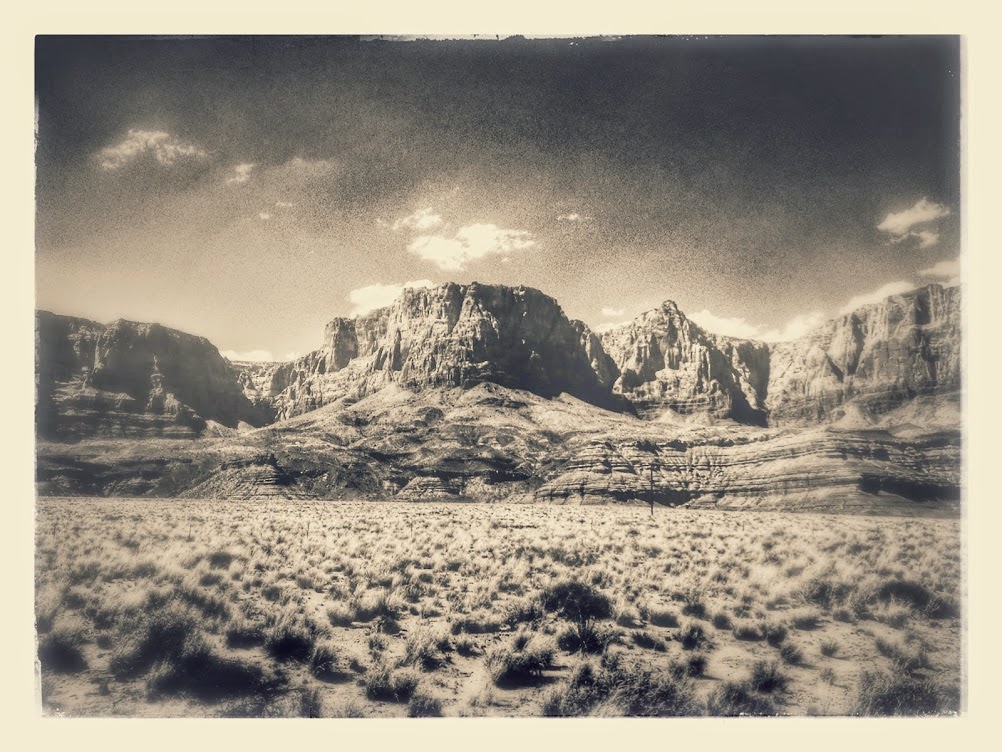
Here are some edited photos I took from our recent visit to the Grand Canyon and surrounding area in Arizona and Utah. It was a fantastic trip and it's such a staggeringly beautiful area! I love to see God's canvas in person and His creative flourishes. I am so thankful we had the opportunity as a family -- or most of our family -- on the trip to see this part of our beautiful country. If you haven't been able to visit this part of the country, I highly recommend it. It is absolutely breathtaking and I'm looking forward to going back and taking more photos.


                                         GRAND CANYON


                                         A HIGHWAY 89 VIEWPOINT

                                          VERMILION CLIFFS

                                          COLORADO RIVER

                                ROCKING V CAFE IN DOWNTON KANAB, UTAH

Saturday, August 9, 2014

An American Journey: A Family's Trip Across The U.S.

                                         The Grand Canyon

Our summer road trip is in the bag.  Twenty-seven days, 8,100 miles, 18 states, one astonishing national park and a million memories. We traveled to Oregon and back in just under four weeks, one big family in one big van. At times our journey was a blur -- the 710-mile drive with just one stop on our last day from Franklin, Tenn. to home comes to mind -- and yet so many other times I wanted time to stop, the sun or moon to stand absolutely still in what seemed like a perfect moment. The few brief hours at the Grand Canyon come to mind. Plenty of other moments come to mind: An evening in the cool summer air of Kanab, Utah; the mind-boggling fireworks from a distant lightning storm lighting up the New Mexico sky; the view from Highway 89 where the Vermilion Cliffs jut up from Highway 89 in Arizona after we had touched the clouds on a 7,000-foot mountain pass.

                                          Kanab, Utah

The American West is absolutely alluring. The sky is so big and blue, the canyons are carved so deep into the earth and the mountains seem to kiss the sun. The landscape alternates between the staggeringly harsh and forbidding deserts and lovely and inviting river valleys. So many times I found myself thanking God for allowing me to take the trip and share it with my family. We enjoyed reunions with so many family members, friends and supporters of ours in our mission work with TEN3 (www.ten3.org) that were most often all too brief. We made new friends and acquaintances all across the country, often of people staggered by the amount of booths we took up at restaurants, or who we encountered during a picnic on the road, or at some other family excursion. Sometimes we spied them giggling as we spilled out of the van as they watched a seemingly endless supply of Sabo lads and lasses.

                                          On a farm near McMinnville, Ore.

Our great adventure has come to a close, but I am so thankful to God that He allowed us to enjoy this time as a family. We're at a point where our older kids are forging their own paths. We managed to enjoy parts of this trip with almost all of our kids and I'm very thankful for that. We'll tell the stories of our cross-country trip for years to come, sharing laughs about what happened when Seth hopped on the teeter-totter in Weatherford, Okla. Or how Gabe and Abram and their little brothers tried to catch steelhead salmon with their hands in a small tributary of the Clackamas River. We'll relive Judah's hurling incident in Dickson, Tenn., or chasing a bull down country roads in VanLeer, Tenn., or scrambling over the rocks atop the Grand Canyon cliffs. I can still picture the vineyards cascading down the cliffs of the Columbia River Gorge, the blueberries bigger than quarters in Grandma and Grandpa Young's back yard, and the sight of the range fire in the arid Eastern Oregon hills above Interstate 84 that had ranchers on ATVs herding their cattle to safe ground. And I'll always remember the countless smiles and laughter from a family having the time of its life.


Sunday, July 20, 2014

Sabo Road Trip Across America: Part I

                                                  Van life. Sabo style. Seth is hungry ...

On Sunday, July 13, 2014, the Sabos launched what can only be described as "The Great Sabo Road Trip: Version 4.0." For the fourth time we would set out in a van across this great country, traversing rolling hills, majestic mountain passes, treeless plains and deep gorges as we aimed our Chevrolet Express west toward Oregon. On a road trip that would be the fourth time we would go coast-to-coast across America, we would tackle what few families would dare to even imagine: Drive 3,069 miles over the course of 5 days in a van stuffed to nearly exploding with kids, luggage, gummy bears, goldfish crackers, various other snacks, pillows, blankets, coolers, an iMac and, as you can see in Seth's grubby little mitt, pizza. No road trip across the country is complete without pepperoni pizza after all.

It's hard to describe in words what it's like traversing the geographic heart of America in a van posing as a moving house full of kids. But let us try.

Day 1: Gloucester to Danville, Kentucky. Just east of Charlottesville, a mere two hours into our journey I hear Judah's van from the depths of the abyss: "Are we almost to Oregon?" Oy. It's started.
We make it to our destination of our new friends the Morlotes -- amazing hosts and wonderful people -- sometime after midnight. We're safe, we're sound and we survived driving through a thunderstorm in a 3-car caravan late at night on Kentucky roads, with only one detour through a McDonald's parking lot.

                                                  The road trip struggle is real, man.

Day 2: Danville to St. Joseph Missouri. We drove 600 plus miles, a journey low lighted by the sight of black clouds, howling winds and debris being blown across I-70 outside of St. Louis. I was pretty sure we were going to drive through a tornado. We managed to pull off the freeway and find cover in a mall while the storm passed. We stormed the food court like locusts, or a tornado, leaving virtually nothing in our wake. If you happened to be in a mall near St. Louis and saw a man with a bunch of little kids riding the escalator over and over again, well, that was me. What can I say? The Sabos are easily entertained.

                                              The elephant is stuffed. The kids are real.

Day 3: St. Joseph to Laramie, Wyoming. What a day. I learned something on our drive and that is that they grow corn in Nebraska. And that Nebraska is a very loooooooooonnnnnngggggg state full of corn. Our highlight in Nebraska, besides watching the corn actually while we hurtled down I80 at 80 mph, was a stop at Cabela's in Sidney. Anyone who is anyone stops at the Cabela's at Sidney, which happens to be the site of company headquarters. As you can see in the photo above, Cabela's was a big hit. A Cabela's is basically a taxidermist's dream. It's like a zoo full of dead animals, and I say that in a good way. An elephant, moose, elk, deer, bobcats, mountain lions, birds, squirrels, fish ... if it's covered in hair or fur and walks in four legs it's pretty much stuffed and in the Cabela's in Sidney. Somehow we managed to walk out of there without buying any firearms. Or trying to stuff an elk in the van for Judah to pet along the way. Other highlights included an amazing thunderstorm in metro Cheyenne. When the storm parted and the sun poked through the clouds it was breathtakingly gorgeous.

                                              Somewhere in Wyoming. Or was it Idaho?

Day 4: Laramie to Boise, Idaho. A 690-mile run in which we only traveled through 2 states. On the East Coast, particularly the Northeast, if you travel 690 miles you're going to hit at least 6 to 8 states. I don't even know if we traveled through that many counties. Wyoming is an absolutely amazing state. For example, we were nearing Cheyenne, or maybe it was Laramie, and Judah had to go pee. It was quite urgent, in fact. We made it to a rest area on a mountain pass at 8,700 feet elevation. That is way up there! Just walking to the restroom is a lung burner! Then when you are up on the high plains of Wyoming where the interstate speed limit is 80 mph, you can look literally as far as the eye can see and not see a single tree. Zip, nothing, nada with leaves. It's grassy hills and plateaus and indigo skies with fluffy clouds you think you can grab when you roll down your window. Our trip had a bit of a hiccup when a hazmat incident closed I80 at Evanston on the southwestern fringe of Wyoming into Utah. A very helpful Wyoming Department of Transportation worker we reached by phone directed us to Highway 30 through Kemmerer and on into Idaho. I have to say, it was a gorgeous drive. Everyone raved about the scenery: The stark, rather desolate landscape of southern Wyoming to valleys where green hay fields straddle the river bottoms and a few herds of antelope roam (Seriously. We saw them.), to big skies and picturesque mountain ranges forming the backdrop of little towns like Soda Springs, Montpelier and Georgetown. We're actually glad about this detour.

Stay tuned for Part II of our road trip, when we pick it up with an incident in Idaho involving a small Sabo within the tight confines of a Dodge Dart that left Claire and Evie traumatized. Perhaps for life ...