Showing posts with label children. Show all posts

Saturday, February 18, 2017

As Parents, Let's Choose the Things that Matter for Our Kids


We can get caught up in "doing" a lot of things for our kids. In our culture we're all about "things."

More things.

Better things.

Lots of things.

We're consumers and takers. We want status and prestige and the best things. We have resulting high expectations for achievement.

We want getting ahead. Pushing. Demanding. Meeting the world's standards.

Let's breathe as parents. I'm reminded as I find myself in that place again. Comparing. Compromising. And I ask myself, `What matters for my kids?'

Love.

Faithfulness.

Commitment.

Compassion.

Selflessness.

Hope.

Perseverance.

To serve and not be served.

To go and make disciples.

To love the Lord with all their heart, soul, strength and mind.

What matters are the things that last.

The things that build family.

The things that transcend culture.

What matters is the love and faith and hope and trust and joy and peace that keep us together when the world around us crumbles.

You don't find it's what the world offers.

You find it reflecting and radiating from the Son sent to live and die and live again for each one of us. All of us.

Wednesday, April 13, 2016

What a heart breaks for. What's our answer as Christians?

What lies ahead?
I came across a quote this morning by a great, but flawed man: "Let my heart be broken with the things that break the heart of God."

Bob Pierce uttered those words many years ago. The founder of World Vision International, a Christian evangelical nonprofit humanitarian aid organization, Pierce was a visionary man with a heart for the hurting. He was also, like many of us, a flawed man and one whose life assumed tragic overtones in its latter years.

We are all imperfect, the unfinished works of a merciful God awaiting perfection in Jesus Christ. I hope as followers of Jesus that we can reckon that truth in all humility. I recognize that as much as anyone as I survey the years behind me, the decisions I've made, the zigs and zags.

It's worth contemplating though as I look ahead and chart a future. What's my heart broken for?

What's yours broken for?

What are the things that break the heart of God and what's our response?

Tuesday, February 23, 2016

In an instant gratification culture, parents should keep an eternal perspective

Keeping the eternal perspective is vital for parents
Several mornings ago I was reading in the book of Hosea and came across a short verse that I've been meditating on ever since. Hosea 8:7 reads, "They sow the wind and reap the whirlwind." It's a biblical principle that you see in Scripture that essentially means you reap what you sow. The easy analogy is that if you plant corn, you will get corn plants and eventually, if the plants receive enough water and sun and you take care of them as needed, you will get delicious ears of corn. You don't plan corn seeds expecting to get green beans, or strawberries, or a filet mignon for that matter.

In the context of the Hosea verse, the prophet was sending the message to the nation of Israel that they will soon be judged for their idol worship -- even though time and time again God had shown them his abounding love and mercy -- and the judgment will feel worse than the sins they committed. The concept is that sin is sown over a long period of time, but judgment is reaped quickly and it can feel very intense.

I have been thinking about this in the context of parenting and how we are given our children for a long period of time before releasing them into adulthood. So the question becomes: What are we sowing into them? What will they reap?

You hear a lot in this culture about "living in the moment" and we are absolutely an instant gratification culture. When you cruise through the Starbucks drive-thru line, you don't expect to dawdle for a half-hour. You want your coffee now, you want it made just right and anything less is unacceptable. At least that's how the Starbucks workers I know describe the experience to me.

It is definitely not okay for wi-fi to go out when you are online. Downloading off the internet should be instantaneous. We don't memorize any phone numbers because they are in our contacts and basically at the tip of our fingers. An instant gratification culture is all about me getting what I want right now. That's America. And it plays out in a bunch of different ways.

We now have what I call "drive-thru church services," where churches get so big they have to have multiple services so you stack one on top of the other -- maybe an hour or so apart -- and get people in, get them out, get the next service going, no one gets hurt. Because, you know, that's what Jesus did when the crowds got so big, right? He held multiple short church services one morning a week. Oh wait, that's not what he did? Interesting.

As parents, we too often live in the moment and want instant gratification in our parenting. The kids' behavior issues are dealt with in the moment and there's not an eternal perspective. For example, instead of dealing with behavioral issues consistently and lovingly at a young age, it's easier for some parents to just get the kid on drugs that basically zones the kid out. Voila! Issue solved! Never mind there's no way that's the best long-term solution. And you tell me. What is the message that sends? What has the child learned from going on drugs that they will carry into adulthood?

Or when behavior goes haywire we respond and deal with just that specific issue and try to fix that one thing. It's a short-term solution. For example, if a kid hits a sibling and then you correct it in the moment and maybe the aggressive one is punished with a "time out" that's so popular today. The kid has five minutes in the corner and then it's over. Here's the problem: You haven't dealt with the bigger issue and that's the one in the heart. Was the child sorry? Does the child understand what he or she did wrong? Do they understand the concept of sin and why sin is bad? Was there restoration?

You can get a kid to do what you want and train behavior, but what's going on in the heart? If you don't deal with the heart, what happens when they leave your house and head off to college, or the military, or take a job and go out on their own? Or maybe as they get older they can do what you want in your house, but what happens when they are out with their friends?

I truly admire Julie over the years because she doesn't parent in the moment. She always takes the eternal perspective and looks to get to the root of the issue. If there's a hitting problem with a small child, she's going to deal with what's going on in the heart of the child and work on that issue and keep working on it until it's solved. If there's an attitude problem in a younger or even older child, it's going to get worked out and dealt with because she does not want that issue carried on into adulthood. I have one older son in particular who spent many a night as a teenager working out issues with Julie. I have another son who spent many an hour as young boy working out issues. It may vary from kid to kid but it goes back to the biblical principle of you reap what you sow.

And it's how Jesus taught: It's the heart that matters. Jesus was surrounded by a culture that had all the outward appearances of righteousness. But what was going on in the heart, particularly among the religious elite and the priests and Pharisees, was evil and wicked. And Jesus called them on it out of love. He loved them to the cross, in fact.

When it comes to our children, we want to sow love and reap love. Too often, however, parents sow wind and reap the whirlwind.

Thursday, January 28, 2016

What I Learned About Buying Local In A Third World Country

Local charcoal sellers. Just not the right ones.
I've traveled to Haiti twice on short-term missions trips, part of a Christian non-profit organization working to establish post-secondary, Bible-based computer training schools. Each time I traveled with a friend from America to the north coast city of Cap-Haitien, home to more than 300,000 people.

Just a two-hour flight from the American wealth and comfort of Ft. Lauderdale or Miami, Fla., flying into Cap-Haitian is akin to dropping off the end of the world. The poverty is mind-blowing, the city nothing short of an intense experience of sights, sounds and smells.

From the sky as you descend the horizon is filled with thin columns of smoke rising from the countryside that's home to innumerable crude, tin-roof homes. Alongside the airport runway is a collection of wrecked, inoperable airplanes. It's not exactly the type of welcome you'd expect from the Cap-Haitien Chamber of Commerce. When you step out of the plane, you're hit with a blast of heat and humidity and you have to get used to sweating because you've pretty much left air conditioning behind.

Everywhere you go in the city you'll find the charm of colorful French colonial architecture reminiscent of the French Quarter in New Orleans. Yet the streets are often lined with garbage and everywhere is the pervasive aroma of smoke -- fire is used to cook food in homes and along the streets and burn trash in smoldering heaps -- mixed with the combination of rotting refuse and sewage. And always the streets are filled with people. Extraordinary amounts of people clogging the sidewalks and spilling into the road. It's a very young collection of people -- 55 percent of the population is under the age of 25 -- and a very poor collection of people where 80 percent of them live in poverty and more than half live in abject poverty.

Vendors line the streets and jam the alleys, selling all manner of clothes, shoes, food, medicines, household cleaning products, soaps, shampoos and everything else. It's like a roofless Wal-Mart Supercenter -- Haitian-style -- everywhere you go. And they sell charcoal. Lots of charcoal.

Haiti has largely been stripped of its trees, hacked down and burned to charcoal that fuels the fires used to cook the food that attempts rather futilely to feed the 10 million Haitians. It's an environmental disaster, but in a country where electricity is basically a luxury -- a very undependable one at that -- fire and the charcoal to produce those flames is absolutely essential.

Largely like fuel in America, charcoal is a commodity that is central to the local economy. There are  fuel stations, but supply can be sketchy, it's almost a luxury in the impoverished nation and you have to get used to seeing guards armed with automatic rifles and shotguns guarding the pumps against thieves.

Each time I've been to Haiti I've had the privilege of being hosted by the same friend, a dear Haitian man who is kind, generous, gracious and everything you'd want in a host. I've stayed with local families and experienced first-hand Haitian life in what I'd call a middle-class setting. Check out this video I shot and edited: Life in Haiti

On my last trip to Haiti, one afternoon the house we were staying at on the edge of the city was short of charcoal. So my friend offered to go buy some. I figured it was a short trip into the city to one of the ubiquitous roadside purveyors to secure a big bag of charcoal. I was wrong. As we journeyed ever farther into the Haitian countryside to find the right charcoal, I learned three things about what it means to truly buy local. And I think the lessons I learned on that day apply to the American ideal of buying local.

1) It's about relationship: Buying charcoal in Haiti should be easy. It's everywhere in the city. Buying charcoal from vendors lining the streets is as simple as buying food in America, whether it's a grocery store, restaurant or convenience store. If you have even a little bit of money you won't go hungry in America -- although you very likely won't be eating nutritious food. But on this particular day we were on a mission. We were going hard-core local charcoal buying.

We traveled probably an hour-and-a-half or more deep into the Haitian countryside for our charcoal. I was seeing signs for the Dominican Republic, that's how far we went. It's like driving 90 minutes to a 7-Eleven for a hot dog and passing dozens of 7-Elevens along the way. We drove past charcoal sellers at road junctions, past them in the town of Limonade, past them in no-man's land on the highway. Somewhere just west of the Dominican Republic we stopped on the road. Down a long driveway I saw a cinder block house with a tin roof, pretty much like a thousand other cinder block houses with a tin roof we passed on the drive.

Our host made a quick phone call. Down the driveway came some women and young kids trundling charcoal crammed into bags like you'd find at Home Depot loaded with 50 lbs. of grass seed. In went two and then three bags of charcoal, along with ants and other bugs on the bags. There were exchanges of warm greetings, the exchange of Haitian money and then the women and kids peered into the SUV I was riding in, apparently awed and humored by the sight of a couple of white guys -- me and my American friend I was traveling with.

After some more small talk we headed back to our home in Cap-Haitien. Past the women and children washing clothes in the muddy river, over the speed bumps that appeared out of nowhere in the road, past the droves of people waiting for rides along the road, past the myriad charcoal sellers, past the naked man with no legs next to an overturned wheelchair. (We passed him both ways. The first time I asked if we should stop and help him. No response. On the way back again I inquired about him and my host gave us the indication the man was crazy and we continued on. Some things from Haiti you never forget. And will never understand.)

I never got the full story of why we went so far for our charcoal. I can only surmise that it was extremely high-quality charcoal sold by people very dear to our host. Or maybe it was just your average charcoal sold by people very dear to our host. Whatever the case, it was very important to him that we get that charcoal from those people. It was about the relationship and about how much it meant to that family. Our trip probably meant they'd eat fairly well for a while. In a world of Amazon and Jet.com and Wal-Mart, there's a lot to be said for supporting the local economy. Whether it's the family-run business in your town or in the Haitian outback.

2) It's about determination. As you read in the previous paragraphs, our charcoal-buying venture was quite the journey. It took determination. It took resolve. Obviously it cost extra. But the final result is that our host was happy, an entire family supplying the charcoal was happy and the people we delivered the charcoal to were happy. Everybody wins. That's the way it should be, even if it requires a little more time, effort and money.

3) It's about the trickle-down effect. A family way out in the Haitian countryside suddenly had money. The kids we saw were literally dressed in rags. They were dirty. The house was primitive. But that family suddenly had an infusion of cash. They could buy food from someone out there in similar circumstances. Or catch a ride from one of the "tap-tap" drivers passing by on the highway looking for customers. Or buy a shirt for a kid. Or whatever. The point is that in a place of desperation there was a glimmer of hope. Things got a little better. I wrote before that some things in Haiti you never forget. One thing I'll never forget is being hot, sweaty and confused, but pulling away from a house in the middle-of-nowhere Haiti and waving to a group of smiling and laughing women and children. With an SUV full of charcoal.


Wednesday, January 6, 2016

What I Learned Traveling The Roads In Africa

There's an opening. Do you see it?

Inside our little red four-door Toyota, it felt like either an unwanted trip to the sauna or what life is like for the Thanksgiving turkey inside the oven. I couldn't be sure which was the more precise analogy. Either way, I was getting baked to a crisp. Relief was not in sight.

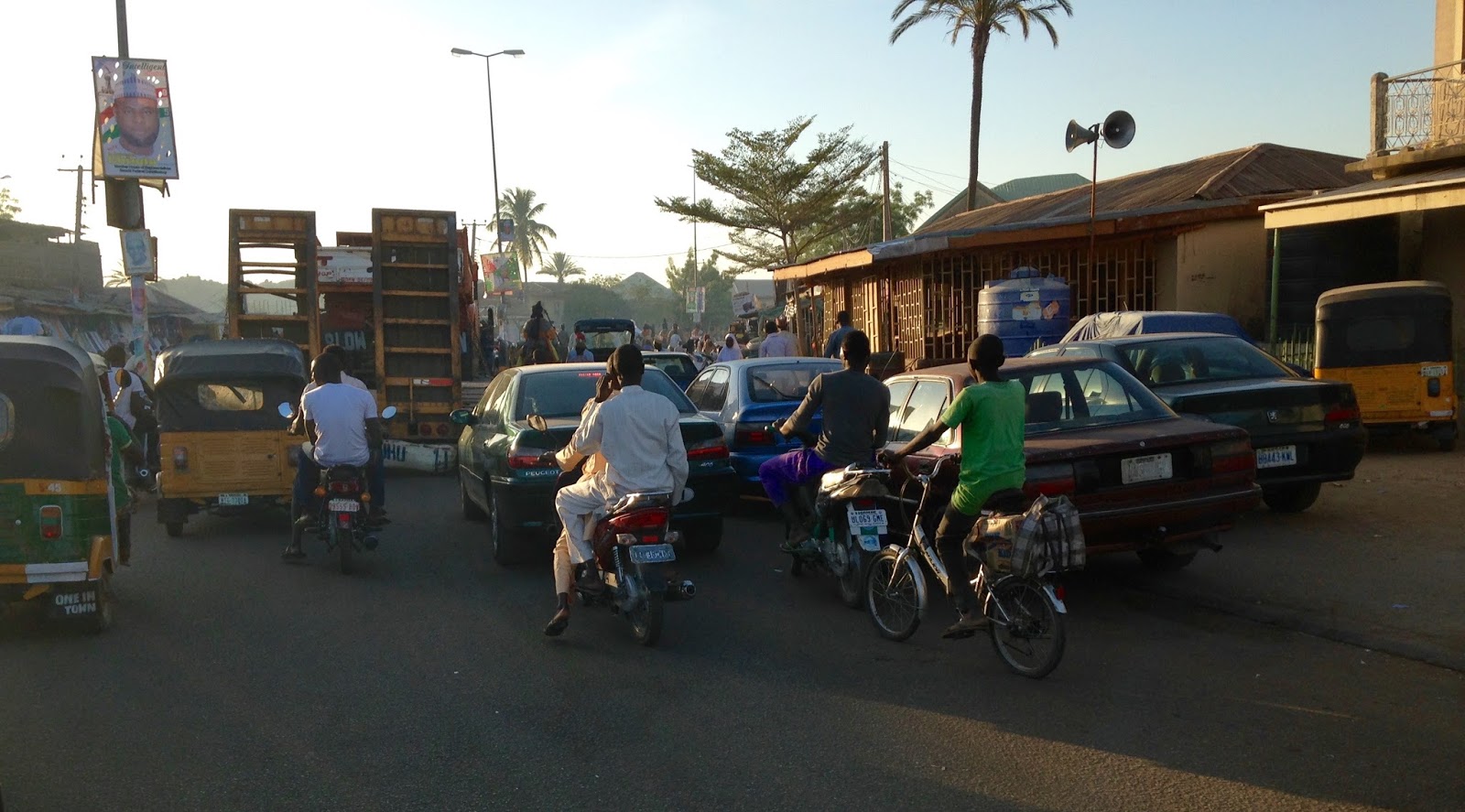
I was with another missionary and a lovely Nigerian educator who was supposed to be taking us to a boarding school for children of Christian pastors and missionaries, many of whom have been left orphaned by Boko Haram terrorists. We were in Jos, Nigeria, a hot, smoky, dusty city teeming with an amazing collection of people, all manner of motorized vehicles, soldiers armed with AK-47s and a wide variety of animals both alive and slaughtered. It was mid-afternoon and we were ensnared in your run of the mill Jos traffic jam. Think NASCAR meets a demolition derby meets Los Angeles freeway parking lot at rush hour and that's about what it's like. 

I was riding in the back seat, trying to remember how much life insurance I had and whether I would perish first of dehydration or in a car wreck. It seemed either scenario was inevitable. My traveling partner was a savvy American missionary who had spent 15 years living among Muslim Bedouins in Niger and was well-acquainted with the inherent dangers of African dangers. I had the distinct impression he was enjoying this because he kept looking back and smiling at me and making small talk about survival tactics on African roads.

We survived that trip to the boarding school and when we arrived I may or may not have kissed the ground upon exiting the car. But that trip and others I took on my journeys across the highways and byways of Nigeria taught me a few important things

1) Focus on the things in front of you. My missionary friend shared this with me after asking if I knew the one thing that mattered when driving in Africa. You see, there is chaos all around you on the roads in Africa and it's easy to get distracted by all the crazy things. There's cars, trucks, buses, three-wheeled taxis, motorbikes -- all with horns blaring and all crammed full of humans and cargo -- and people, animals and obstacles like vehicle-swallowing potholes or assault rifle-toting soldiers at checkpoints.

It would be easy to get lost in the mayhem. It can be overwhelming and fearful thinking of everything that could go wrong on the road. But your main concern is always moving forward -- sometimes inch by inch, sometimes at great speed --  eyes with a laser focus on what's in front of you. Distractions can be costly. Same for indecision. Decisiveness and aggressiveness are rewarded. So is fearlessness, for that matter.

So what is the Lord calling you to do that's in front of you? What leap of faith? The world needs followers of Jesus whose desire is to fulfill the Great Commission. That plays out in our families by modeling a faith to our kids that's centered around a love of Jesus, with hearts of grace, mercy and compassion and a firm commitment to please God with our lives. It plays out in hearts to reach the lost, comfort the afflicted and share our faith. "Most assuredly, I say to you, he who believes in Me, the works that I do he will do also; and greater works than these he will do, because I go to My Father." (John 14:12 NKJV)

2) It's a race for the space. The faint of heart are left behind, literally, on the roads in Africa. There's no room for the tentative and hesitant. As you're focused on what's right in front of you, you will see periodically among the jam of traffic a glimmer of light. It's an opening. The first to that tiny crack in the circus of vehicles wins. It's that simple.

Every day there's a race for the space in our hearts. The world or Jesus? I contend that this race starts first thing in the morning when we make the choice to either get in the Word or find another way to spend our time. Commitment to Jesus starts early in the day continues all day. Our focus should be continually on Him. It's the life Jesus modeled: "Now in the morning, having risen a long while before daylight, He went out and departed to a solitary place; and there He prayed." (Mark 1:35 NKJV)

3) Know you're going to have to improvise and adapt on the fly. On one trip across hundreds of miles of Africa we had to plan our trip to avoid Muslims leaving Friday afternoon prayers because there's a heightened danger of being an American traveling through certain areas. Even then, however, you never know what could go wrong or what you might face. The occasional goat streaking across the "highway" or maybe a herd of oncoming bulls. Seriously. 

As near as I can tell, there are no rules, or guidelines or even suggestions about driving protocol in Africa, other than generally keep to the right. Speed, lane usage, when to pass, the use of turn signals, driving a car in general operable condition that's safe for the roads, the number of suitable passengers -- human and animal -- cargo limits and other vehicular type rules are all highly subjective. Since that's the case, just know that something will go wrong on your trip and then deal with it.

On one trip I was with some men who actually made a repair on the fly with a shoelace and wire until we could get the vehicle to a suitable "garage." When we got stuck behind dozens of parading Muslim horsemen in the town of Bauchi that created a horrific traffic jam it meant our tight traveling schedule got thrown out the window and we would soon be driving the last leg of our journey at night. Let me just say that you don't want to drive at night in Nigeria. It is tempting misfortune at the highest level. We made the best of it however, and overcame potential disaster. And lived to write about it.

There are plenty of things that are going to "go wrong" in our lives. There are things that are going to require improvisation and adaptation. But here's the deal. Either we believe God is in control and there's a purpose in the things he's taking us through or we don't. It's that simple. "Have I not commanded you? Be strong and of good courage; do not be afraid, nor be dismayed, for the Lord your God is with you wherever you go." (Joshua 1:9 NKJV)


One other thing. It's a funny thing, too, as I think back about careening around Nigeria and the adventures and travails I experienced on the roads. It's like nothing else I've experienced. I miss it.

Sunday, December 27, 2015

Happy 13th Birthday To Gabe

Gabe teaching Seth the finer points of rivah wading.
Gabe is celebrating his 13th birthday today, which means that among other things we're back up to having five teenagers in the house.  Gave is a brother with a big heart and an easy, contagious laugh. Just ask Claire. When Gabe really gets to cackling Claire just loses it and starts giggling as well.

He loves animals and every morning faithfully transports our bunny, Flopsy, from her spacious hutch to her bunny cage in the yard. Flopsy has become something of a neighborhood mascot. I've had people ask where I live and when I describe it several people have said, "Oh, the house with the bunny in the yard." Yep.

If you see Gabe in the front yard, he will wave to you. And keep waving until you wave back. So please wave back. Gabe loves the beach and catching minnows and little blue crabs in his net. He loves the snow and likes to ride his bike around the yard and will spend hours on end building Legos.

He likes to play soccer but is one of those kids who likes more to be a part of the team and making friends than the competition aspect of it. He's worked hard over the years and has become a very good soccer player, but he's one of those kids that is simply a great teammate who encourages the other players, is unselfish and works hard.

He's a joy to have as a son. Gabe is kind, patient, thoughtful and a good big brother, quick to help his little brothers.

Happy birthday Gabe. We love you.

Friday, December 25, 2015

A Time To Reflect, A Time For Thanks


It is officially Christmas Day, 2015. It's somewhere the other side of midnight and things are out of whack -- outside at least. It's a warm, steamy night in Virginia. Thick clouds obscure the full moon and stars that are up there somewhere and the windows are open and the ceiling fans are humming. And still it's hot in here. I refuse to turn on the AC. It's late December. That's ridiculous. Even if it means I can't sleep because I'm too hot.

But the other side of being sleepless in Gloucester is that the kids are all in bed, the house is quiet, the Christmas tree is lit up and the presents are spilling out from beneath it. It's like this every year for me, these nights that by the light of the Christmas tree I take a few moments to reflect on my life over the past year.

I'm not going to lie. It's been a hard stretch in many ways going back the past 14 months or so. The thing that comes to mind first is two miscarriages. Two blessings we've missed out on. Our babies give us so much joy as a family, there's an excitement and an anticipation that builds through the pregnancy. There's a sense of wonder with the little kids when we bring home a new baby. For so many years we've celebrated another birth, welcoming a new baby brother or sister so routinely it's become a part of the fabric of our lives. There's always been another baby and those days are drawing to a close. Or maybe they have drawn to a close. Either way, I miss them.

I've had some ongoing health issues over the past year that doctors can't quite figure out and on some really rough, painful nights I've trundled 2-year-old Seth into our bed. I like to listen to him breathe and I put my head right up against his soft cheek. He's a snuggler and he'll burrow into me and for a little while I forget what's ailing me. He comforts me the way our babies always have. There's been many nights when it's me and a baby in my arms in a darkened house and listening to those fast, little breaths, feeling that skin like cotton and smelling that new baby smell and everything is alright in the world.

My work as a missionary ended earlier this year and it's just ... I don't know how else to describe it other than painful. I was unable to raise enough support to continue as a missionary working with an organization that launches Bible-teaching schools in Africa and Haiti. The cold, hard truth is that I wasn't any good at asking people for money. It's a flaw of mine where I pretty much stink at asking for help. I don't like goodbyes either but that's another flaw, another story. The missions organization I was with is doing work that changes lives and offers hope both spiritually and economically to downtrodden young people and I loved being a part of it. The people in the organization are wonderful and they're doing great work. I've seen and met many people whose lives have been changed through it. It feels like failure to leave it behind. It's hard. I don't really know how else to put it.

I'm extremely thankful and grateful for the work I'm doing now and the opportunity some friends of mine here in Gloucester gave me to work with their PR & marketing firm after leaving the missions work. It's a huge blessing and I really believe we're doing great work. But it's just one of those things I wrestle with, where my heart is to spread the gospel and to elevate lives and I was a part of that ... until I wasn't. It's an ongoing conversation I have with God, wondering what it's all about and why. But learning to trust in His plan when life doesn't make sense is essential Christian living. A Christian is believing -- knowing -- God has something else afoot and is waiting. Always waiting as it says in the book of Hosea, to wait on our God continually. Always expecting. Always ready. The life of a follower of Christ is gripping the faith to take the next step when you don't know where that foot will land but taking it anyway. I'm learning it. I'm working at it.

But in so many ways these are all such little, trivial things. This past weekend at Taylor's wedding affirmed what a gift I have with my family. My kids all love Jesus. That's a blessing. We're happiest when we're all together and my kids are patient, kind and loving to each other and they love to be with Julie and me, even the older ones. Sadly, that seems all too rare in this culture.

In a few hours the kids will all be up. The little kids will frantically be trying to get the older ones out of bed and we'll gather in the living room in our pajamas. The kids will pass around the presents under the Christmas tree, many of which they got for each other and we'll take turns opening them. I'll fix my traditional seafood chowder and I'm thinking it will be so nice outside that maybe we'll walk down to the beach. We'll have the whole day together. That's the best part. Really it's the only part that matters.

Thursday, December 24, 2015

A Wedding Toast From One Brother To Another

The three amigos saving one of them from a gator's toothy grip

One of the things I'm so blessed by with my family is how much love my kids have for each other. I have a brother-in-law whose words echo through my mind frequently when I think about my kids. He was telling me once how much he enjoys being around my kids and he said quite simply, in part awe and part genuine fascination it seemed, "They're so kind to each other."

The way my family breaks down is there's little groups of my kids that are naturally closer to each other because of being born so close together, as well as other factors. Our three older boys, Brenton, Taylor and Ethan, comprise one of those groups. When we get together and they start telling stories about the things they did back in the day it's hilarious. Apparently the "10-year rule" -- where they can finally talk about the crazy things they did 10 years ago and not worry about getting in trouble -- comes into play. Their bond is strong and lifelong.

I've often thought about the nature of their love for each other and I always come back to it's a reflection of their faith in Jesus. They model the kind, compassionate, loving, serving heart of Jesus. For me, it's a joy to watch and be a part of.

I saw examples of this love for each other over the weekend at the wedding of Taylor & Bethany. The kids stepped up serving in so many different ways. Evie painted an amazing portrait of Taylor & Bethany she gave to them as a wedding gift. Brenton and Ethan served as groomsmen, taking care of a ton of little details  and big ones as well to honor their brother. Claire, MerriGrace and Madeline  were absolutely lovely as they played and sang songs as a trio at the start of the wedding as people entered and got seated. And all of the kids pulled off their parts in the wedding without a hitch.

And as best man for Taylor, Ethan gave a speech at the reception. I'll link to the full speech below that is up on Youtube, but I loved it. He talked about how Taylor has become a remarkable man over the years and he said that love is the strongest force in the world. As he closed the toast and raised his glass, he spoke the words that he told us had came to him in a dream:

"My final hope and my prayer and my blessing to you all Bethany and Taylor, is that your love would be faithful like the rising sun, that it will be as lasting as the mighty mountains, it will be strong like rushing water, as precious as silver, passionate like a raging fire, sweet as a robin's song and richer than a thousand kings. I love you both. Here's to Taylor and Bethany."

Youtube link: Ethan's wedding toast

Tuesday, December 22, 2015

What A Family Gets With A Wedding

Taylor & Bethany
Somehow we pulled it off. A rehearsal dinner for about 60 people the night before the wedding of our son Taylor and his lovely bride Bethany was going smoothly. It was no small feat, believe me. Julie and several of our daughters and even sons had labored in preparation, preparing baked ziti, a chicken lasagna, chicken marsala with rice, a huge salad, rolls and even five cheesecakes -- all hauled 570 miles from our house to Berea, Ky. But the food was savory and several people asked who did the catering.

Why, we did!

But as the Hayes and Sabo extended families and wedding party ate and mingled and laughed and shared stories, I was walking down the basement hall of the River of Life church where we were holding the wedding on my way to retrieve more forks -- always a good sign when you're hosting  a party for 60 that you've prepared the food for -- when the pastor posed a question to me. It was simple, really: Could I speak with him a moment?

He motioned me into a room across the hall and we sat down. I admit the words, "Uh-oh" went through my mind. But I quickly learned that Pastor Tim just wanted to tell me about Taylor. I won't go into the details but he simply had a lot of very nice things to say about him and we had a great conversation. And I gained a new friend -- two actually because his wife, Anne, joined us. One of the words he used to describe Taylor was "solid." Which is funny because that's one of the exact words my family uses to describe him.

He is solid in the sense that he is faithful and selfless, kind and loving, reliable and generous. And so many other things. It plays out in a thousand little ways and a bunch of big ways. He will jump in and do the dishes and no one even asks him (that's a big deal in my book!). Or he will round up the kids for a lively game of soccer in the front yard. Or he will tell bedtime stories to the little kids that have them laughing so hard they can hardly breathe. He is always willing to help, always willing to give and always quick to love. He's that embodiment of a person who reflects and radiates the love of Jesus. I can't describe in words how much it means to me to call him my son.

Over the course of the wedding I had several people -- fellow students, Pastor Tim, some of Bethany's family members -- pull me aside to tell me about Taylor and how much he's meant to them. It was a totally unexpected blessing.

I say all this because I've been thinking about the dynamics of our family and how they have changed now. This is our first wedding. We've entered a new season where our kids are truly forging their own paths. They are falling in love and getting married and starting lives together and, soon I imagine, perhaps very soon, starting their own families.

But there's something else as well. Something that goes right along with a wedding. It's a wedding gift, I guess you'd say.

We have a new member of the family, someone who we've all quickly come to love quite dearly. Someone who is kind and quick to help and quick to love. Someone who is thoughtful and graceful and who loves to spend time with our little kids and will chat with Olivia for seemingly hours on end. She's someone who is a perfect complement for Taylor.

My son Taylor has a companion for life. My other children have a new sister. Julie and I have a new daughter. We couldn't be happier. Welcome to the Sabo family Bethany.

We love you.

Saturday, December 12, 2015

What We Do Best As A Family Is ...

Family should be one big celebration
Maybe it's because there's a lot of us. Maybe it's because we love to laugh and make each other laugh. Or maybe it's because we've always had little kids around who reach big milestones on a regular basis. Whatever the case, over the last several days I was struck by something that happens a lot here at Team Sabo.

We celebrate.

We celebrate little things. Like a lost tooth. The displaced little tooth is taken around the house and shown with great pride to each brother and sister. The new gap in the mouth is admired and analyzed and there's long discussions of whether the Tooth Fairy is broke thanks to the Sabo kids.

We celebrate funny things, like 4-year-old Judah telling MerriGrace about his latest dream. It was a dream where he forgot to put on his pants and underwear but went out in public anyway. Now I when I have had those dreams of being buck naked in public, it was more like a nightmare. Judah had a different response: "Whoops!" he told MerriGrace. That's a story worth celebrating.

We celebrate attempts to conquer the English language, which is no small feat for a 2-year-old like Seth. He likes his apples cut in half, with the skin off and smothered in "pinka butter." Although he means to say "peanut butter," we all think "pinka butter" is just so much better. Because it makes us laugh.

We celebrate one of the biggest moments in a Sabo kid's life -- the day of turning 10 years old. -- with regularity. You see, at the age of 10 a Sabo lad or lass becomes a "big kid." There's all sorts of benefits to being a big kid. Not only have they hit double digits, but they can stay up later at night. They are entrusted with more freedoms, like playing video games. There's also a certain amount of responsibility -- they may be counted on to help out more with the little kids. Now that we can definitely celebrate.

We celebrate when the kids in college come home for the holidays or on a weekend. Sometimes the younger kids make welcome home signs. Or they color pictures. Sometimes they bake cookies. Sometimes, like tonight, we honor a special request and make chicken and mashed potatoes with gravy. All the time there's a ton of hugs.

In another week we'll celebrate in a big way a first for our family. Taylor is marrying Bethany. The excitement in the house is palpable. We've been doing a countdown for months. Today Olivia was modeling the dress she is going to wear. We giggled over the snazzy shirts and ties Judah and Seth will be wearing. We've dug out photos of when Taylor was but a wee Sabo to share at the wedding reception. And the great thing is that we'll have many, many more of these types of celebrations.

We celebrate potty training and riding a bike with no training wheels and going to Busch Gardens and family vacations and picking blueberries and getting baptized and a little kid reading their first book and getting a driver's license and birthdays and a million other things.

We celebrate life because life should be a celebration. I view this life I have, my wife and all these kids, as a gift from God. And gifts are worth celebrating.

Saturday, November 28, 2015

When Kids Bicker: A Mom's Solution

Peace, love and no bickering

For some reason, I still get surprised when our kids at college say how much they can't wait to come home. They love being home and soak it in. There's playing with the younger kids -- "Hey guys, let's wrestle," says Ethan -- and there's home cooking -- "Mmmmmm. Mashed potatoes," says Evie -- and movie nights -- some serious laughs when "The Russians Are Coming! The Russians Are Coming!" is on the TV.  Games, telling stories about the crazy things the older kids did when they were little, soccer matches in the front yard, impromptu music sessions, eating ... check that, LOTS of eating, are all in the mix when the family is home together over a holiday or weekend when the collegians return.

But it's not always peace, love and family harmony. Sometimes the Sabo family kids experience a dreaded condition called "bickering." Perhaps you are familiar with this condition as well. It can be highly contagious and very debilitating. It has the potential to be deadly as well, killing any and all joy in the house.

Are you familiar with this `bickering' disease? Well, we're here to help. At no cost to you we have interviewed a world-renowned expert in the field of child bickering and sat down with a very brief interview with this noted authority. Here's a transcript of the interview.

Me: Good morning.
Julie Sabo: Good morning.
Me: You look great by the way. I love you.
Julie Sabo: Um, thanks. What do you want?
Me: Oh, nothing babe. I just wanted to ask you a question if you have a minute in between getting Seth dressed, fixing breakfast, answering a million questions from little kids and settling an argument over the ownership of that toy sword that seems to be causing some sort of internal family conflict.
Julie Sabo: And the question is ...
Me: Well, it seems to be particularly apropos at the moment. But I'm wondering how you solve bickering between children.
Julie Sabo: Just curious, but how many kids do you have?
Me: Same as you my love. Fourteen.
Julie Sabo: And how long have you had kids?
Me: Uh, well if my math is right around 26 years.
Julie Sabo: And you don't know the answer to this question yet?
Me: Well, I just thought it would be best to hear from you. You have a way with words, not to mention being an expert in child psychology.
Julie Sabo: I see.
Me: Soooooo, the answer is ...
Julie Sabo: I try to get to the root of the problem. I'm training and working on character. So instead of just training behavior in the moment, I'm thinking bigger picture. I want to be training and teaching in non-conflict moments. So I work on patience, kindness, sharing, love and forgiveness.
Me: Wow. That's really good.
Julie Sabo: Thanks.

And there you go. Some key points to highlight from my perspective include these quotes:
--Training in non-conflict moments
--Working on patience, kindness, sharing, love and forgiveness

I tell you. I'm going to start writing this stuff down!

Thursday, January 22, 2015

The World Record For One Woman Having Babies

Matt & Julie -- Relative minor-leaguers in the `kid' department

There's something I need to clear up. Some accusations, aspersions, and rumors that have come our way over the last several ways. It's been on my mind recently and I just want to clear the air. All those people who say we have a lot of kids? You're wrong. It's just not true. We're not even in the minor leagues when it comes to kids.

How can I say this? Pretty easily. And I'm not even comparing ourselves to the Duggars and however many kids they have at the moment. You see, I've done some research. I've asked the right questions. I've probed, nerded out, googled, whatever you want to say. And I'm here to tell you that the truth of the matter is that we might only have a starter set of kids when you compare us to the legend of baby-making. The woman with the womb in the Birthing Hall of Fame. The one whose maternity dresses we are not worthy to wear. (Especially me.)

Just out of curiosity, what do you think is the world record for one woman giving birth? Is it 24? Would you say 30? Can you imagine, gasp, 40? Let me just say, you're getting warm.

Friends, strangers and even Sabo blog stalkers, there is one woman who stands alone in recorded Western history for the fruitfulness of her womb. She put the `pro' in prolific. Let's just say she's pro-life like no one else.

Between the years of 1725-65 (Which, if my calculations are correct, is 40 years ... that's 40 years of giving birth ladies.) Ludmila, a Russian peasant woman and wife of Feodor Vassilyev,  gave birth to 69 children by 27 births. That is not a typo. That's 69 babies. Sixty-nine. Say it out loud for effect.

Yes, it's true. According to the Guinness Book of World Records, all the women put together reading this blog probably don't have enough kids between them to compare to Ms. Vassilyev. So how did she do it? Uh, let's rephrase that. How did she have so many kids? The key is multiple births. All you young mothers out there start taking notes.

She had four sets of quadruplets, seven sets of triplets and sixteen sets of twins. So there you go. It's all about multiple births. Got it? Not to mention the fact that she had babies over the course of 40 years. Does that mean she started cranking out wee lads and lasses at 14 years of age and finished at 54 years old? I'm not sure. Whatever the case, apparently she seemed to enjoy the whole child-birthing thing. God bless the woman, eh? Here's another thing: All but two of the children survived infancy. In 18th century rural Russia no less.

Take a minute to let this all sink in. Sixty-nine babies. No hospitals. No running water. No disposable diapers. No long, hot showers. No epidurals. No birthing rooms...no wipes, baby food in jars, formula, or anything else like it.

What a woman.

So I hope this encourages you all to rethink the whole child-rearing thing. Maybe recalibrate what constitutes having kids. And having lots of kids. While you're thinking about that, I'm going to go ask Julie when she's ready to start having kids.


Thursday, December 4, 2014

My Nigerian Experience


Things I won’t miss about Nigeria:

--Hearing the muezzin or whatever he was blaring from a nearby mosque in the pre-dawn hours. I can deal with the roosters, the car horns and anything else of a noise variety. That one alarms me, though, and the first time I heard it I thought a terrorist attack was imminent;

--Rice. Whether it’s white, or jollof, with red sauce, with beans, or in some other form, I’m ready to explore other culinary dishes;

--Driving. As near as I can tell, there are no rules to driving in Nigeria. Nor are there even guidelines, let alone suggestions. I don’t know what it takes to get a traffic ticket here, but let’s just say road cops in the USA with a monthly quota of traffic tickets to fill could get ‘er done in about an hour here. I’ve been on divided highways with a raised median and if traffic is stopped in one direction, why they just hop the curb and start driving against traffic in the oncoming lanes. Right by cops. Why is this okay? And passing is always an option, even going uphill, past a tractor-trailer on a blind corner. I feel like I cheated death on the roads for two weeks;

--Showers. Picture a faucet, a small bucket and cold water. You’re feeling my pain. Like any spoiled American, I like my showers long and hot. The struggle is real, man;

--Electricity that constantly fluctuates. It’s worse than being in a relationship with Taylor Swift – the power is on again, off again. On again, off again. On, off. It makes it really hard to recharge my cell phone. Oh, the horror of it!

--Vivid dreams. I suspect it’s the anti-malarial meds I’m taking, but man have I had some vivid dreams. They’re the kinds often that make you wake up with a start and you can’t get back to sleep … then the muezzin fires up. Last night I had a dream I inherited some very valuable books in a very finely crafted wood bureau and had to get them from New York to Boston without anyone knowing it or else something really bad was going to happen to my family.  Oops … now everyone knows it;

Things I will miss in Nigeria:

--The weather. Hot, dry days in the 80s and cool nights in the 50s. It’s like summer in Central Oregon. Perfect;

--An Arabic shawarma from Jam’s, a little hole-in-the-wall eatery over by one of the other missionary compounds. Chicken, garlic, pickles, salad and a couple of other things wrapped inside a tortilla-like thing. Oh, the joys of a Jam’s shawarma!

--The sights. Every day you see something that blows your mind. Take, for example, the cargo on a motorbike, to include masses of humanity, livestock, goods such as firewood, or all of the above. Just when you thought it was not humanly possible to pack more onto a motorbike, you see more;

--The people. So friendly. I made many friends here and made them quite easily. One of the things that tickles me is how often they say, “Welcome, sir.” I’ll meet someone and greet them and they’ll reply, “Welcome, sir. Thank you, sir. Welcome, sir.”

--The children. Universally polite and friendly, if not somewhat surprised and curious at times to see a white guy. I will never forget the look on the kids’ faces when I took their photo and turned the camera around and showed them the digital copy. Priceless. I believe for many of them it was the first time they had seen their own picture. Their faces were a thousand words;

--The faith of my fellow Christians. You can hear it in the prayers. It’s a deep, profound trust and love of God that I imagine comes in part in a place where life is truly fragile. In the course of five days earlier on my trip I was with three people while they received word that someone close to them had died unexpectedly. There are no guarantees here and life is hard, very hard. The one thing you can trust is God’s love and the hope we have in His son, Jesus Christ. I have a great love and admiration for the people I’ve met here. God bless you all. I’ll miss you and look forward to seeing you again.

Friday, October 31, 2014

When Ebola Strikes The Community: 15 Funerals A Day

Three orphans from a Sierra Leone family, led by a boy who is 17.

I confess, it was a hard day for me. It's one of those days I've been through before with Julie. A trip to the hospital for a surgical procedure after a tiny beating heart inside her was silenced for reasons that remain a mystery. Just two weeks ago that tiny heart beat strong. Then some bleeding, a trip to the doctor and a weaker beating heart. Then later, more bleeding and a devastating silence. We've been blessed abundantly, 14 times to be exact. We've held and caressed all the tiny little babies, each time with inexpressible joy. I've gazed mostly through tear-stained eyes at the new little miracle in my hands, always thankful for this perfect life I'm holding and equally relieved that Julie's ordeal has passed. I wonder as I hold the infant about the new life that's being forged ahead of us, how it's a birth of new dreams and hopes and above all else, love. A deep, abiding love.

Julie and I have been through mornings like this one five times. Each different, some much more difficult than others. None of them easy. I guess I endure a silent mourning, some sort of brave face. Things get bottled up inside and I imagine it's not healthy. I don't know. It's a flawed coping method, I recognize that. Anyway, I walked around the hospital grounds in Williamsburg this morning while Julie was in surgery and I found this fiery red maple leaf on the ground. It was strikingly beautiful and the thought crossed my mind that its beauty was perfected in its death. A thousand leaves had tumbled to the ground around it yet that one stunning leaf nestled among the mulch caught my eye. I snapped a photo and I would imagine it's burnished into my memory forever. I don't pretend to understand the hows and whys of mornings like this one, except that I know that it is God's will for us. That's where I rest and that's where I find peace.


And then amidst my personal struggles I get emails like these. From a man I've never met in person -- we connected from thousands of miles away through my missions work -- whose faith is tested every minute, every second. Rev. Samuel Kargbo is awash in a sea of death in Sierra Leone, a thousand lives around him at the mercy of a vicious disease. Ebola has cut a harvest of death through his neighborhood, his city, his country. "We see the number of deaths increasing by the day and fear is generated in us, except that we have the inner man to strengthen us," Kargbo writes.

The fear is so palpable that people are afraid to go to the hospital when they are sickened, for fear that they will be diagnosed with Ebola, he writes. "This tells you the other reason for the death of many people during this period. That is part of our responsibility to educate and sensitize people to go to the hospital."

If you look closely at the photo at the top of this post, behind the three orphans who sought food to carry them through the day, you will see a lady on the ground behind them. She has lost 13 members of her family. "It is only three of them that are surviving," Kargbo writes. "The lady lying down has not escaped the danger."

For Kargbo, death surrounds him. The nearest cemetery to his community is burying 15 people a day. "We do feel the terror of death hovering, but we are covered by the wings of our Lord," Kargbo writes. "Despite the numerous deaths, we are presently engaged in reaching out with love to the community, especially addressing the needs of the orphans."

A grandchild of his has a cough and running nose. His youngest daughter complains of general body pains and his family is taking precautions to not touch her. "With the first aid treatment, if she does not show improvement after three days, we will be left with no option but to get her to report to the hospital," Kargbo writes.

His emails are a window into a suffering I'm not familiar with and Lord willing never will be. I don't say that his words give me perspective on any grief I may be experiencing because what he has to say doesn't necessarily diminish what pain I feel. What I do know is that I have an overwhelming sense of empathy for Rev. Samuel Kargbo, his family and the people of Sierra Leone and surrounding countries. I can't fathom the fear, helplessness, weariness and host of other emotions he must experience every moment. Yet it's abundantly clear that this man has a deep, abiding faith in God that's unshakable. The fires of Ebola have forged an immovable faith. I am awestruck by it. I pray that God moves to contain this disease. I ask you to pray as well. So often as the world implodes around us, that's all we can do. 

"Once more," Kargbo writes, "I say many thanks for your prayers. We surely need those prayers."

"Once more," Kargbo writes, "I say many thanks for your prayers. We surely need those prayers."

Tuesday, October 14, 2014

Three Things Daily Bible Reading Teaches Your Kids

Madeline leads worship during a recent Calvary Chapel Gloucester baptism.

Way back in 1992 in the dusty eastern Oregon border town of Ontario, we stumbled upon Calvary Chapel. We loved the church and found it refreshing that the key element was the Bible and teaching through it verse by verse, chapter by chapter, book by book. Over the years we have attended or visited many Calvary Chapels. Now I pastor a Calvary Chapel and our family is very involved in the church, with Brenton the assistant pastor and other Sabos at various times leading worship, teaching in children's ministry, leading Bible studies and serving in other capacities.

One of the primary distinctives of Calvary Chapel is its emphasis on the Bible. We hold the Bible in high regard and consider it required reading around the Sabo house. Although we don't "make" any of our kids read the Bible daily, I know that those of the reading age take the time pretty much daily to read it. I was talking to Brenton about this earlier tonight to get his thoughts on why it's important for youth to read the Bible and what it teaches them. Here's a few thoughts.

1) Reading the Bible daily teaches discipline. The Christian life is one of discipline. Prayer, Bible reading, worship and meditating on God's word are all disciplines that separate the casual believer from one who is fervently following Jesus. It blesses me so much to see my children, even as young as elementary school age, reading the Bible daily right before bed, or in the morning when they first get up. No one asks them to do it, but they see examples set by their parents and older siblings. Being in the Word from a young age will mature them beyond their years and they will learn a discipline that is a vital part of their faith. The maturity in faith that comes from reading and knowing the Bible will extend to other areas of their lives and you will see them own their faith in Jesus from a young age.

2) Reading the Bible daily makes God's Word come alive. More than simply knowing the stories and characters of the Bible, devotional reading helps youth understand how God's Word is alive and applies to their life today. They can see how God worked through history as part of His plan to bless and save humanity through His Son and they can translate that to God working in their own lives. If they see God working in their lives, they believe He has a purpose for their lives and will be able to navigate the inevitable trials and tribulations of life because they are tethered to Jesus. A key component of having God's Word be alive and dynamic is that the Bible comes into play as a key component to making decisions. When youth learn to make decisions based on truths from the Bible they read and can apply to their lives, they are light years ahead of most adults I know -- even those in the church who aren't equipped to make good decisions because they rarely, if ever, open a Bible.

3) Reading the Bible daily serves as a counter-balance to the world. Kids these days are buffeted by an extraordinary amount of worldly enticements designed to influence their behavior. Media, advertising, technology, even the lure of sports and other passions, can all pull kids away from their walk with Jesus. Reading the Bible serves as the anchor for kids, linking them firmly and steadfastly to their Savior, Jesus Christ. One of my sons was telling a story about a friend of his in college whose life has seen remarkable maturity in faith. The difference? Even though he was a churchgoing lad and participated in his youth group at his church, he said he didn't really care to read the Bible. Since heading off to college, he started getting into God's Word and it's a key component to his new found Christian maturity.

No doubt I can come up with a whole host of other things that daily Bible reading teaches our kids. But one last thought: Name something else that would be a better way for your child to spend his or her time.


Friday, October 3, 2014

When My Daughter Writes Beautiful Essays

Evie Joy

My lovely daughter Evie Joy, or Evie as we all call her, is a talented artist and writer. I love her creativity and her passion for art and writing. She polished off this college admission essay last night and Julie happened to read it then read it to our family. It is wonderful. It brought tears to her mama's eyes. I hope you enjoy it and are as blessed as much as we were. I love you Evie!

Home
I always sit in the front row, usually one or more of my sisters are with me. There are always a multitude of sounds: a rich voice pouring out words read from a worn, tearing notebook, two little newborns cooing or crying gently in the back, faraway laughter and happy shouting that lands faintly on all our ears, sometimes I hear a gentle laughter bubbling forth from us, the audience, sometimes murmurs of agreement, sometimes there are tears, but most of us don’t really notice these sounds; we are too busy listening to the voice and following along to the ancient words he’s reciting. 
The rows are sparse, there are not many people on a given day, but we are clustered together, leaning in to one another to whisper our thoughts or scrawl little notes in the margins of each other’s Bibles. There are some people who wear dresses or dress shirts with ties, some people might wear a dressy-casual attire, there are a few who come in jeans and t-shirts, but there are no cliques among us. Looking out at us, one could see us in an array of colors of diversity, we all are starkly unique from the rest. There are large families that sit together, single moms with a few children in tow, young families that have a baby or two with them, young adults that cluster near each other, and excited middle schoolers that have just graduated from “little kid class.”  We are an informal group; we are not afraid to poke good fun at each other, we are not afraid to laugh at ourselves. 
The man is at the podium, most days in khakis with a button-up shirt. He usually wears a smile that can easily turn into a smirk whenever he attempts to make a joke. Attempting meaning that he makes a joke, and after a long moment of silence our sound man will play a track of crickets chirping, and then we all laugh. He takes a moment to laugh at himself along with us and returns to the story. I pretend I am immune to his jokes, but you see I find puns funny seemingly against my will. He’ll take time in his sermon to share something from his life that proves, contrary to what we would like to believe, that pastors deal with the same struggles we do. He’ll rub his bald head tiredly as he points out a convicting area of scripture, he’ll laugh at the unexpected triumph a character in the story had. The man at the podium is my dad, and he stands there every sunday morning reading and teaching from his Bible. I lost track of how many times he’s bought a new Bible because his has fallen apart—his favorite pages slipping out, running out of room to write in the margins, and having to duct tape the binding together—and most times I find myself getting lost in the words as well. Whether the teaching is on an Old Testament prophet called to tell Israel their sin or a widow putting her two mites into the offering cup because it’s all she has, the sermon never fails to both convict and encourage me. 
After he is done teaching, my brother steps up to the podium with a guitar in his hand; he is going to lead us in one last song to end the sermon. His voice carries throughout the sanctuary, singing out the words that wash over us as praises to our Savior. His voice is high and happy, filled with a kind of emotion that nobody could be immune to. He often dresses down, almost opposite my dad. At twenty-five he wears t-shirts he’s had since high school from various church camps and simple blue jeans. He is an excellent worship leader and a gifted teacher. He usually closes his eyes and strums the guitar he’s known and loved since middle school and we all stand and worship together, singing out praise songs together. The last song of the service is most often the most meaningful to me because it is after I have heard what God has said to me through my dad, the pastor, and I am ready to start a new week in light of what I had just learned. 
After the service is over we go out into the foyer for coffee and fellowship. Fellowship comes from a Greek word that means communion, contribution, and distribution. We stand together with coffee in our hands as we share about our week, about what God taught us, about how it was encouraging or discouraging or eye-opening or hard. We listen to others share and perhaps we’ll offer advice or encouragement. I have seen many people prayed over during fellowship, sometimes I’m in the group praying and sometimes I’m the one being prayed over. We laugh together, we cry together, we might share deep things, we might share light things, but we are always there for each other. We commune together, we contribute to each other’s lives, we distribute our thoughts. We are a church, but we are also a family.
I am close to everyone that goes to my church, the older adults are like my grandparents, the middling adults are like my aunts and uncles, the young adults are my brothers and sisters, and the young children running around are my nieces and nephews or my little brothers and sisters. I feel comfortable enough to share the hard things I’m going through and I love to praise and rejoice with my family. I believe that church is about people coming together to praise God, read the Bible and hear the pastor’s teaching, and fellowship together. I feel as though my church fulfills all of these, and church is the place I always feel the most comfortable.

I am the most content at church because it is full of people who care for me and who I care for, it is a place of learning and growing, and it is full of God. As soon as I walk into that building I feel God’s presence as if he was there with us, sitting next to me as we begin worship, lending a comforting shoulder as I cry about the struggles in my life, there with us as we pray for one another, standing amongst us as we share with one another. I can’t imagine going many sundays together without once going to church. I hear the Word of God and it teaches me, I commune with my fellow believers and it encourages me, I worship God in song and it blesses me. Every sunday feels like a family reunion. My church is like my home to me, and I find that I wouldn’t want to be anywhere else.

Tuesday, September 30, 2014

Fighting Ebola Empty-Handed And A World Away


Imagine a world where you can't leave your house because death lurks outside the door. Imagine a world where the body of your neighbor rots in the stifling heat and gathers flies inside her door and no one comes to take it away for a proper burial because surely they would die as well. It's hard to imagine because we can't. It's virtually impossible for us in America to take our mind to a place where life is truly but a vapor, a visible wisp of matter that can be extinguished seemingly in an instant.

This is life across a wide swath of West Africa, where the ebola virus has brought death to the doors of thousands of families in Liberia, Guinea and Sierra Leone. We've all read or heard the reports of ebola through media, with the latest alarming news that more than 1 million people could be afflicted with the virus by early next year. My personal knowledge of ebola comes through Rev. Samuel Kargbo, a minister in Sierra Leone who we have been working with in TEN3 (I am communications manager for the Transformational Education Network, or TEN3) to establish one of our computer training outreach classes at his school. Those plans have been put on hold as the ebola crisis deepens in Sierra Leone.

Last week, I received an email from Rev. Kargbo, who thanked me for praying for him and his family. It is a very terrible thing to see neighbors around you dying from a disease, he wrote. So far, he has lost three close relatives who live nearby. There are many dead bodies lying in houses -- four, more or less, in some houses, he wrote.

Rev. Kargbo continues: "The sad thing that has happened is this: since as I told you last the government could not meet the needs of the affected cases, quarantined families, the wife of my relative who died yesterday, his 22-month-old daughter, and two ward children have left the house without being quarantined. Who knows what may happen to the people they come in contact with? We pray that they never contracted the virus, but if they did, then it is obvious they will definitely pass the virus to other people."

Rev. Kargbo describes how the surviving relatives scattered to different parts of the city and country the morning of Sept. 23. He also describes what has transpired over the past two weeks. "Five people have died in connection to the same first victim that died on Wednesday, September 10," he writes. "Two of the women are neighbors who took care of the corpse before burial. We called the 117 number that is given to us and the burial team's number but nobody came to bury the first corpse.

"We (my wife and I) have discussed about how we could intervene but we could not because the lady had left the house this morning before we could send food stuff there. We have called her to come back to the house as soon as possible so that we could share from the little that we have. That is what the Bible says is true religion, taking care of the orphans and widows. As stated earlier, due to several factors, the citizens’ needs could not be adequately addressed in this crisis time, except friends and relatives step in to alleviate the suffering and deaths. One corpse that is said to have died four days before the burial team came to collect it and one infected person were collected three days ago close to our house. We do not want to do that but we have restricted the inflow of children into our compound to play. One way that we could be further involved in helping to save lives, especially lives of those relative who have left for the village, the wife and the baby is by assisting them with food items and restrict their movements for three weeks and see if they will report sick. If any one of them reports sick we will guide them going to the hospital for the test to find out if it is ebola. According to the teaching we receive, early detection and early treatment gives hope to the affected victim to survive."

He closes the email by saying he has temporarily closed his school for three weeks to assess the situation. At that point he will reassess the crisis and determine if the school should remain closed. So far, three of his students have fallen ill, Rev. Kargbo wrote. None of them have ebola, however.

I have asked him how I can help but the situation is so dire and chaotic in Sierra Leone that it doesn't appear there's anything I can do. Except pray. This week, my supporting agency for my mission work, Serving In Mission, has called for believers to have a week of prayer for the end of the ebola crisis in West Africa. Remember people such as Rev. Kargbo in your prayers. Remember the countries of West Africa. Remember Psalm 46:1: "God is our refuge and strength, a very present help in trouble."

Tuesday, September 16, 2014

Succeeding In One Thing That Really Matters

Succeeding in something that matters. A Thanksgiving Sabo family soccer match.


I was walking down the hall tonight to say bedtime prayers and saw my 10-year-old son reading his Bible. No one had asked him to, it's simply a legacy handed down from his older siblings that was started by Brenton when he was a lad. Every night, without fail, I can see Abram, now 15, reading his Bible. It's always one of the highlights of my entire day. The thought struck me that my kids are doing something that matters. Francis Chan has a fairly famous quote that sums up my thoughts this evening: "Our greatest fear should not be of failure but of succeeding at things in life that don't really matter." 

I've thought about this quote a lot recently as I survey the landscape of American Christianity through the lens of parents. And I'm pretty darn sure we're succeeding at things that don't really matter. So many people I've known over the last several years who had been churchgoers are partaking of the youth sports elixir. They spend their Sunday mornings at the soccer, baseball, field hockey, or any number of other athletic fields, watching their kids play. And the message they are sounding loud and clear to a generation of youth is that sports is more important than church. And we wonder why Millenials and others are walking away from the church? I  would suggest one factor is that it's not important to parents.

Look, being at church for the sake of being at church -- treating it like a club -- is a whole separate subject. In our family, going to church isn't optional and subject to whichever kid's travel sports team -- or any other event for that matter -- has a game or match that morning (Disclaimer: None of our kids are on travel sports teams). But neither is it this legalistic rite we do every Sunday. Going to church on Sundays is our time to corporately and individually worship the Lord, as well as pray, study and learn Scripture and fellowship with brothers and sisters in Christ. It is vital. We look forward to it. We desire it. We are strengthened and encouraged by it. We are equipped by and through our worship, prayers and Bible studying on Sundays to navigate the travails of the week. We are also able to encourage our church family on Sundays.

At our church, Calvary Chapel Gloucester, even our young kids are studying through the Bible at their level. In the church, we study through the Bible verse by verse, chapter by chapter, book by book. Last week we studied Acts 4:1-12. Next Sunday we'll pick it up in Acts 4 verse 13. We have seen a tremendous amount of fruit in our lives and in the lives of our children in the systematic study of Scripture and prioritizing what we do on Sundays as a family. When our older kids leave the house, they choose to find a church in which to worship. It's vital to them and I thank the Lord for that. They have a personal relationship with Jesus Christ. They are firm in their faith. 

I truly believe that we are succeeding in something that matters.

Friday, September 12, 2014

Things Kids Say, And Sing, Are Simply The Best

Judah deep in thought on where to find faith.

To me, age 3 is right about the golden age of childhood. At least from a parent's perspective. The child's vocabulary is expanding by leaps and bounds, they've cleared the diapers stage, there's an uninhibited glee they often express over the seemingly littlest things and their personality blossoms. Judah is our resident 3-year-old and he has a way of putting things that is just so, well, Judah.

For example, one evening a while back he came to me with a very serious question. "Dad," he said, "can you keep an eye on me?"

After suppressing a laugh, because he was quite earnest, I told him I sure could. Then I asked why he wanted me to keep an eye on him.

"I might be up to something," he said.

I told him I appreciated the heads up and then went and kept an eye on him.

The other morning after getting up and playing for a while he came to me while I was in the kitchen. He had some news he wanted to share with me.

"My tummy tells me I'm hungry," he said.

I told him it's good to listen to our tummies when they tell us they are hungry.*

Another thing about Judah is that he loves music. He loves to sing and is always busting out in song. His current favorite is King and Country's "Fix My Eyes." Part of the chorus goes, "Fight for the weak ones, speak out for freedom, find faith in the battle, stand tall but above it all..."

The other night Judah was singing at the top of his lungs his own version of "Fix My Eyes." The chorus went like this: "Fight for the freak ones, find faith in the bathtub."

I love it. I actually like his version better than the original.


*Unless you're like me and have listened to your tummy tell you it's hungry way too much. There are times you shouldn't listen to your tummy when it tells you that it's hungry.

Monday, September 1, 2014

Three Key Things For Husbands I've Learned In Marriage


Twenty-four years ago today at a little church in Canby, Ore., I exchanged marital vows with my lovely bride, Julie Young, who wore the same dress her mother wore on her wedding day 24 years earlier. We were 21 on that lovely September day, when I became a dad to her little boy of 16 months. We wed on Labor Day weekend at the start of my senior year of college at the University of Portland, launching an adventure that at this point is nearly 9,000 days long, includes 13 more kids and has endured approximately 90,000 diapers and a move across the country. We've had plenty of struggles but the sweet memories we've made together are incalculable. Here's a few things I've learned about marriage.

Surrender. I am at my best as a husband when I can surrender my selfishness and my desires and serve my wife. My model in this life is Jesus, who came to earth to serve and not to be served. I freely admit it's a constant battle fighting selfishness. But my wife, and then my children, should be assured by what I do -- and say -- that I value and treasure them. Quite often that plays out simply in how I spend my time. Is it to fulfill my wants and desires or is what I'm doing showing them how much I love them? Too often I've chosen to do things I want to do ... I'm a work in progress! Here's the thing though: My fondest memories are times I spend with my wife and family and when I'm participating with them or knowing they are doing the things they enjoy, even though it's not always the way I wanted to spend my time. Essentially, my relationships are elevated when I take the lesser position.

Serving. This plays out in how much I contribute to the family operation, which at its core is serving my wife. Husbands, serve your wives. It's that simple. ("Husbands, love your wives, just as Christ also loved the church and gave Himself for her..." Ephesians 5:25) There are certain tasks I've taken on over the years as a way of serving my wife and contributing to the operation of the family, such as grocery shopping, cooking and, yes, even changing diapers, to lighten the load on Julie. I've fallen well short in many other areas, however. I'm working on them, including taking the 2 littlest ones with me when I haul older kids to soccer practices and games to try to give her more free time away from the demands of wee ones. She's earned it after years of sacrificing her desires for our family and I'm committing to serving her more.

Relationship. To me, the most important relationship in our marriage is my relationship with Jesus. My marriage works best when I am spending time with the Lord by reading His word, by praying and in meditating on Scripture. It's a way to learn to model this earthly existence after my savior's. The word used to describe Jesus the most in the New Testament is `compassion.' If I bring compassion to my marriage, it entails numerous actions: Love, tenderness, empathy, humility, sensitivity, kindness and so much more. A compassionate husband is a good husband.

I still have so much to learn about Julie and marriage. I am learning how to get things right, how to submit, to be quick to apologize, to surrender and serve and have compassion ... I could go on and on. My prayer is that God will give me the wisdom, selfless love and heart to be a loving husband who treasures his wife.