Showing posts with label ten3. Show all posts

Monday, December 29, 2014

My Eye-Opening Experience At A Nigerian Boarding School

Doing the wash at a Nigerian boarding school.


I wanted to share a link to a post I wrote for my missions work over on another blog I've launched with the Transformational Education Network. It's an inside look at my eye-opening experience at a Nigerian boarding school. It was one of those experiences I will never forget. It's something I believe can be a call to action for those of us who follow Jesus Christ.

Check it out here: Boarding school

Friday, November 28, 2014

A Transformational Thanksgiving in Nigeria


It is the wee hours of Thanksgiving in America, but here at 7:30 a.m. Jos, Nigeria, I am chugging a bottle of “F.A.M. Vita” vanilla yoghurt in a dark guest house room without power. The pervasive, acrid smell of campfire smoke – people still cook with fire here and you can drive down the street and see garbage burning – lingers with me, as always. Outside my open window I can hear the noise of the bustling city: cars and three-wheel motorized buggies zipping down the street, horns honking, people talking and someone on an air horn announcing something. I am thankful.

I am here on a mission trip with the Transformational Education Network. I have traveled with our CEO, Joe Gallop, who presented at a symposium yesterday and discussed technology and transformational education. More than 100 educators and students attended and both Joe and I are very pleased with how things went. The Lord truly blessed it and I met a young man with a communications degree who I hope will help me with gathering photos, video and stories from here in Jos at the school we partner with, E.I.C.T. that I can use in my TEN3 communications.
 
Today we will be attending a workshop where Joe will speak on “Essential Values in Transformational Education.” It’s the first of a two-day workshop and we are looking forward to seeing what the Lord will do today. Yesterday went very well and we were able to connect with a number of educators interested in the Transformational Education Network curriculum and our method of education. One of the things that appears to be coming out of this trip is forming a network of schools – private, government and others – that can act as a forum and exchange of information, ideas and solutions to help achieve transformational education. Our role will be as facilitators and advisors and we will be working on how best to accomplish this exchange of information.

Tomorrow I will be traveling several hours with an American missionary named Eric Black to his post in Billiri in Gombe State. I should say that Lord willing, I will go. I have to check with the SIM security director to discuss whether I should go due to concerns about safety in that area. I think everything will be fine and it will be good to travel with Eric, meet his family and learn about the education center he is operating in Billiri.

After I return, probably on Monday, Joe and I will be traveling to the communities of Zonkwa, Kwoi and Kubacha (I think I got those right) southwest of Jos in the neighboring state of Kaduna to explore the potential for launching TEN3 computer training outreach programs. We also were invited by one of the educators at the symposium to visit her private secondary school here in Jos, so it looks like we will be heading over there as well.

As for my general experience here in Nigeria, I have to say I have met some wonderful people. They are universally friendly to me, greeting me with big grins. Whenever we exchange greetings people often reply with “Welcome sir. Thank you sir. Welcome sir.” It makes me smile. The traffic is crazy, the police are everywhere and they carry AK-47s. It’s the dry season here on the Nigerian Plateau so it’s dusty, hot during the day in the 80s (I’m not complaining!) and cool in the night down to the 50s.

On the 4-hour plus drive Monday morning up to Jos from Abuja, where we landed Sunday evening and spent the night, we traveled through at least a half-dozen and probably closer to 10, military checkpoints. Soldiers with AK-47s manned the checkpoints, I’m assuming because the area has seen its share of Muslim-Christian conflict. Boko Haram, the Muslim terrorist group, operates in the area occasionally and more than 100 people were killed earlier this year when they set off bombs in the bustling outdoor market that’s several blocks from the compound where we are staying here in Jos. Mostly we were just waved through the checkpoints, though a few stopped us simply to chat, it seems. One engaged us in conversation and our driver, Audu, asked the soldier if he was born again. We talked about being born again, Jesus, salvation and he said he was born again. He was quite offended we didn’t have our Bibles with us in the car – they were in our luggage in the back. I’m glad he didn’t shoot us. (Just kidding!) At another checkpoint a soldier asked Joe and me where we were from. When he found out we were Americans he said he wants to go there someday. What he really wanted, though, was for us to bring him a white American wife. I told him I could see what I could do and maybe make that happen. He got a big grin and then reached in the car and we “pounded” fists. It’s the first time I’ve ever pounded fists with an AK-47-toting Nigerian soldier manning a highway checkpoint. I have to admit it was a pretty special moment.
I have many more stories to tell, but we’ll save those for other times. Blessings to you all this Thanksgiving.

Sunday, October 12, 2014

Spending Thanksgiving In Africa

Shooting some video in Haiti

On the Saturday before Thanksgiving I am scheduled to fly to Nigeria on a two-week missions trip to a place that's made international news for the violence perpetrated by Muslim terrorists targeting Christians. I will be heading to Jos, where the missions organization I work for is operating in a school providing Christ-centered education and computer skills. It will be an honor to meet the educators and students in Jos who have been undeterred in the face of the relentless onslaught of violence fomented by Boko Haram.

We are expecting up to 100 educators to gather for TEN3 workshops at the 2014 Transformational Education -- Nigeria event. Later, I will be traveling to outlying communities where TEN3 hopes to launch computer training outreaches. I will be shooting video, interviewing, writing stories and shooting photographs for TEN3.

Last week I put together a 60-second video for TEN3 using video footage and photographs from two of my missions trips to Cap-Haitien, Haiti, and TEN3 staff photographs from Zambia and Nigeria. For a little flavor of what I'll experience, check out the video here:  TEN3 Missions Video

I would also appreciate your prayers for the trip. Pray for the safety of all of us and that God will be glorified in our time in Nigeria as we bring the hope of Jesus and Christ-centered education to a place in the world that desperately needs it.

Tuesday, September 30, 2014

Fighting Ebola Empty-Handed And A World Away


Imagine a world where you can't leave your house because death lurks outside the door. Imagine a world where the body of your neighbor rots in the stifling heat and gathers flies inside her door and no one comes to take it away for a proper burial because surely they would die as well. It's hard to imagine because we can't. It's virtually impossible for us in America to take our mind to a place where life is truly but a vapor, a visible wisp of matter that can be extinguished seemingly in an instant.

This is life across a wide swath of West Africa, where the ebola virus has brought death to the doors of thousands of families in Liberia, Guinea and Sierra Leone. We've all read or heard the reports of ebola through media, with the latest alarming news that more than 1 million people could be afflicted with the virus by early next year. My personal knowledge of ebola comes through Rev. Samuel Kargbo, a minister in Sierra Leone who we have been working with in TEN3 (I am communications manager for the Transformational Education Network, or TEN3) to establish one of our computer training outreach classes at his school. Those plans have been put on hold as the ebola crisis deepens in Sierra Leone.

Last week, I received an email from Rev. Kargbo, who thanked me for praying for him and his family. It is a very terrible thing to see neighbors around you dying from a disease, he wrote. So far, he has lost three close relatives who live nearby. There are many dead bodies lying in houses -- four, more or less, in some houses, he wrote.

Rev. Kargbo continues: "The sad thing that has happened is this: since as I told you last the government could not meet the needs of the affected cases, quarantined families, the wife of my relative who died yesterday, his 22-month-old daughter, and two ward children have left the house without being quarantined. Who knows what may happen to the people they come in contact with? We pray that they never contracted the virus, but if they did, then it is obvious they will definitely pass the virus to other people."

Rev. Kargbo describes how the surviving relatives scattered to different parts of the city and country the morning of Sept. 23. He also describes what has transpired over the past two weeks. "Five people have died in connection to the same first victim that died on Wednesday, September 10," he writes. "Two of the women are neighbors who took care of the corpse before burial. We called the 117 number that is given to us and the burial team's number but nobody came to bury the first corpse.

"We (my wife and I) have discussed about how we could intervene but we could not because the lady had left the house this morning before we could send food stuff there. We have called her to come back to the house as soon as possible so that we could share from the little that we have. That is what the Bible says is true religion, taking care of the orphans and widows. As stated earlier, due to several factors, the citizens’ needs could not be adequately addressed in this crisis time, except friends and relatives step in to alleviate the suffering and deaths. One corpse that is said to have died four days before the burial team came to collect it and one infected person were collected three days ago close to our house. We do not want to do that but we have restricted the inflow of children into our compound to play. One way that we could be further involved in helping to save lives, especially lives of those relative who have left for the village, the wife and the baby is by assisting them with food items and restrict their movements for three weeks and see if they will report sick. If any one of them reports sick we will guide them going to the hospital for the test to find out if it is ebola. According to the teaching we receive, early detection and early treatment gives hope to the affected victim to survive."

He closes the email by saying he has temporarily closed his school for three weeks to assess the situation. At that point he will reassess the crisis and determine if the school should remain closed. So far, three of his students have fallen ill, Rev. Kargbo wrote. None of them have ebola, however.

I have asked him how I can help but the situation is so dire and chaotic in Sierra Leone that it doesn't appear there's anything I can do. Except pray. This week, my supporting agency for my mission work, Serving In Mission, has called for believers to have a week of prayer for the end of the ebola crisis in West Africa. Remember people such as Rev. Kargbo in your prayers. Remember the countries of West Africa. Remember Psalm 46:1: "God is our refuge and strength, a very present help in trouble."

Wednesday, September 10, 2014

In A Big Family, Communication Is Very Important

Letting people know they are too close to the edge would be a good form of communication.

In a large family, having open lines of communication are very important. For example, say you were on a road trip across the country and made a quick pit stop off of I-80 in Nebraska. It would be very important to have open lines of communication between the passengers and the driver when one of the passengers noticed a brother or sister running out of the restroom and sprinting to catch up as the van headed back out to the endless cornfields freeway. In this case, it would be very important to say something. You know, like let the driver know there's a child left behind. Or maybe something like this: "DAD! STOP THE VAN! WE FORGOT _________ (enter the name of any of 10 children you might have accidentally left behind)!

On any given day in the Sabo house, there might be three dentist appointments, two separate soccer practices, picking someone up from school and dropping that someone off at work, then later picking that person up from work, a shopping trip in order to feed a small army our family, a night Bible study and an emergency late-night run to the store for ice cream. To achieve maximum efficiency in the Sabo house on days like this it requires the ultimate in communication. Husbands, read closely here because what I'm about to say may revolutionize your marriage: The key to communicating with my wife is that I need to "talk" to her. Yes, actual conversation that goes beyond grunts and "yes" or "no" or other primitive forms of male communication. I have discovered that it's often good to "talk" to my wife in the morning to achieve the previously mentioned maximum efficiency. Alas, sometimes I fall short. I still believe Julie has the ability to read my mind and it's not uncommon to get a phone call from her asking what I'm doing. That's usually a good sign that I should be doing something else, which typically involves a matter of importance in the Sabo household. And apparently I believe Julie is not the only person who should be able to read my mind.

On Sunday afternoon I left for Charlotte, N.C., to spend a week long retreat with my co-workers in the Transformational Education Network. I was dropping off Ethan in Richmond on the way so he could pick up his car and head back to Hampden-Sydney College in Farmville, Va. Monday morning got off to a great start with my colleagues until I got a text from one of my kids. Here is the text I got from my 17-year-old daughter Evie: "So mom just told me you went to North Carolina for a week ... I just thought you had decided to stay a night at Farmville when you dropped off Ethan. I asked mom when you'd be back today and she said, 'Oh...about a week.' "

Although I love to communicate with my children by texting, sometimes even when they are in the next room, that was not a text I enjoyed receiving. In fact, I was horrified. I should have my `Dad' card pulled. How did one of my kids not know I was going to be gone for a whole week? I extended my profuse apologies to Evie and am still kicking myself. When I get home I'm going to ground myself. After I make it up to her somehow. Like sharing my calendar with her on Google+ maybe? Would that qualify as good communication?


Monday, September 8, 2014

A Gloucester Game-Changer: `Pocahontas Lived Here'

Gloucester: The view ain't so bad. Neither is the history.


When I tell most people I am from the lovely, photographically enchanting enclave of Gloucester, Va., they give me a blank look that says, "Where's that?" Or a blank look that says, "I thought Gloucester was in Massachusetts." Often I've aided the geographically-challenged by saying the Virginia strain of Gloucester is across the river from Yorktown and Williamsburg, or an hour east of Richmond on Chesapeake Bay, or 2 1/2 hours south of Washington D.C. and a light bulb goes off above their head. But I've been scrapping all that lately and just saying, "Pocahontas lived here." Eyes light up at the mention of Pocahontas.

Just this morning it happened. I am in Charlotte, N.C., for the week for a retreat/conference with my co-workers in TEN3, Transformational Education Network (www.ten3.org). We are here at the headquarters of Serving In Mission (most notably in the public eye recently because two of SIM's doctors contracted Ebola recently while serving in West Africa) from literally around the world. From California to Zambia, 10 of us TEN3 missionaries are here  from around the globe to talk strategy, plan, pray, encourage and exhort each other on our mission to provide transformational Christian education materials and technology skills to disciple and equip young people in Africa and the Caribbean.

This morning I met another missionary who is here for a separate conference. This missionary serves in Ethiopia but is from Australia. When she asked where I was from I told her Gloucester, Va., and explained roughly where it was. Then I mentioned it's where Pocahontas lived. That was the game changer. She had seen the movie. You know, the Disney animated film "Pocahontas." Even though the scenery in the Disney flick is utterly and completely lacking anything remotely close to what you'd find in Gloucester -- for example, the next waterfall someone stumbles upon in Gloucester will be the first -- and I have yet to meet a animals or trees that can talk, it's one of those things that's made Pocahontas famous.

Beyond the Disney flick, I asked the missionary what she knew about Pocahontas. She was an Indian princess, she said. That appears to be part of the fascination with Pocahontas; other fascinating things include that she was an Indian princess, saved John Smith's life, conversed with animals and traveled to England, among other things. In May, when I was still working as a reporter for the Daily Press, I attended an event in Gloucester in which the Virginia governor, Terry McAuliffe, paid a visit to the historic site of Pocahontas' village, called Werowocomoco, on the banks of the York River. He hopes the site will become a national park, something that would truly put Gloucester on the map. Historians and government officials say that around the world, Pocahontas is more well-known than George Washington and other iconic American figures. They say that if Werowocomoco received a designation as a national park, visitors from around the world fascinated by the story of Pocahontas would pay a visit.  I bet I won't be explaining so much where to find Gloucester if that's the case.

Here's a link to the story I wrote for the Daily Press about Pocahontas' old stomping grounds becoming a national park: Werowocomoco story

Oh, and one other thing. We look forward to you paying a visit to see us in historic Gloucester.

Thursday, August 21, 2014

Burying Lizards Alive And Getting Rich Quick

                        Lizard/amphibian thought bubble: "Don't bury me alive!"

If someone told you to bury a lizard and you would get rich, would you do it? Perhaps on the surface it sounds silly to you. Or does it?

My day job as a missionary is communications manager for Transformational Education Network, an organization dedicated to bringing Christian education and computer skills training to young adults in Africa and the Caribbean. In that capacity I get emails from around the world and came across one yesterday that got me chuckling. Christie Dasaro, our TEN3 director in Nigeria, wrote about an ongoing "Computer Holiday Adventure" computer training outreach session that is being held at our TEN3 school in Jos, Nigeria. The session has 16 students, some of them touching a computer for the first time, she wrote.

Some good news out of the session is that two of the students gave their lives to Christ and six students rededicated their lives to Christ after a Bible lesson of, "What do you believe and why the Bible?" Christie wrote that she has "never been excited teaching CTO Bible like yesterday. To God alone be the glory."

She relayed one interesting story as the students shared beliefs in their culture. One student said, "If you catch a lizard alive and bury it, after three days you will become wealthy." That sounds patently ridiculous to us in America, eh? Not so fast. We have plenty of strange cultural beliefs: The pot of gold at the end of the rainbow; Santa Claus; The Tooth Fairy (who, by the way, needs an income-generating strategy because the Sabo household has lost an amazing amount of teeth); Affordable health care. Coming from a culture in which a survey several years ago showed nearly 40 percent of lower-income people believed buying lottery tickets was a good wealth-building strategy, we better not judge.

The manager at the local convenience store near my house said she has many customers who spend hundreds of dollars a day on the lottery. I was in there once clutching Seth in one arm and a pop in the other and the dude in line in front of me dropped $600 cash on scratch tickets. I blurted out, "Feeling lucky today?" He looked at me and shrugged. When he left the clerk said he usually spends more. Wow. Just wow.

Christie ended her email about the student's lizard story by writing, "Thank God, the lesson opened his eyes to see the lies of the devil and know the truth." It's a small thing to have this child's eyes opened about a faulty community cultural belief. But in the big picture, through the TEN3 session his eyes are being opened to a much greater truth: the gospel of Jesus Christ.

When I quit my newspaper job in May to work with TEN3, I left the relative security of more than two decades of work as a reporter knowing that in four years of missionary support raising through Serving In Mission, I had built up only about a year's worth of funds. I felt strongly the Lord's leading in becoming a missionary with TEN3, affirmed through much prayer and confirmation in Scripture, and have faith the Lord can supply the funding to continue beyond next summer. My faith isn't in burying lizards alive, or the lottery, or some other scheme, but it's in the God who has provided for me and my large family for the past 20 plus years. We lack nothing and have been blessed tremendously.

One other thing moves me to work with TEN3 and see lives transformed around the world. Our schools are open to anyone of any beliefs, but the gospel is proclaimed unashamedly. In her email, Christie asked for prayer for one of the 16 students, who is Muslim and is hearing in the class about the hope of salvation through Jesus Christ. In a world that seems to be coming unhinged, riven by violence, hopelessness, warfare, disasters and unfathomable turmoil, the only true peace is in Jesus. One of my favorite verses is John 14:27, where Jesus says, "Peace I leave with you, My peace I give to you; not as the world gives do I give to you. Let not your heart be troubled, neither let it be afraid."


Thursday, July 24, 2014

Homeschool Field Trip to Oregon Fish Hatchery

                                          Sabo boys at the hatchery fish ladder

We set out for Oregon this summer for several reasons, among them to include spending quality time with family and friends and visiting and updating supporters and potential supporters of ours for our missionary work with TEN3 (www.ten3.org). We have been achieving all of that and in between I purposely, intentionally and even deliberately have resolved not to get cheated on our time in Oregon. Hence, within two days of our arrival I had canned 30 pints of Marionberry and boysenberry jam,. Later one evening I took the kids down to the Canby High School track for a Sabo Olympics and later took a scenic, back road drive with the family when the highway was readily available. Today was another of my "Oregon resolution" days.

Julie and our five daughters went and visited her Aunt Judy in Gresham so the lads who remained, Abram, Gabe, Eli, Ezra, Judah and Seth, decided to take a field trip. Well, technically I decided. I wanted to visit a fish hatchery out in Oregon and today offered the opportunity. The kids were simply along for the ride and trusting Dad wasn't completely out of his melon with this idea of a good time. Our "educational" excursion proved to combine all the key and required elements of homeschooling field trips: Brain stimulation, fun, adventure, varying degrees of danger, a stop at a rural convenience store for chips and snacks and man versus nature that has the potential to go awry. At least those are the required elements of my home school field trips. Certainly there's a time and place for art galleries, museums, operas, symphonies and visits to historical sites. Just not today.

We set out just after lunch for Milo McIver State Park and the Clackamas Fish Hatchery in metropolitan Redland, Oregon. Or maybe it's metropolitan Viola, Oregon, neither of which may even be on a map. So maybe it's metro Estacada, Oregon? However you slice it, we got there by rolling in our van through the hills of northeastern western Oregon, bisecting and snaking through the hay fields and Christmas tree farms and splendid Cascade foothills vistas. It's gorgeous. Even on a relatively cool, cloudy day. At the fish hatchery we were all alone. Except for a few workers who paid us no mind. Inside the hatchery was everything you would want to know about salmon, in this case primarily steelhead and Chinook. Outside the buildings in holding pens we saw hundreds of the monstrous critters and dreamed of salmon on the grill. Well, at least I dreamed of landing one of those 40-lb. behemoths for a grillfest.

                                          Salmon

After touring the hatchery, we hiked a short distance down to the Clackamas River and that's where the fun and adventure really began. First off, the water is cold. The boys were shocked at how cold it is this time of year when they plunged in up to their ankles. They are used to the York River in Gloucester, Va., where the tidal saltwater is 80 degrees or so in mid-July. A fisherman we met on the Clackamas, Jason from southwest Portland who could not seem to get over the fact that I had 8 other kids who did not make the "home school field trip" trek, estimated the river was 55 degrees. I explained this novel concept of "snow melt" to the boys and how the rivers in Oregon are fed by melting snow from the mountains. Which makes the water freezing. In reply they shivered. I guess they understand.

We arrived at a bend of the Clackamas River where several fishermen, including Jason, were trying to snag the elusive salmon. My boys promptly started throwing rocks in the river. I tried to direct them away from the fishermen and mostly succeeded. The mouth of the creek where the salmon head upstream to the fish hatchery is at the bend so the older boys ditched their shoes and socks and clambered over rocks to the creek channel. It was a bit dicey for them getting out there over the rocks, but while stationed along a rocky chute they nearly managed to wrangle, or noodle, or whatever you want to call it, a few steelhead out of the watery chute to shallower calm water where we would've, I don't know, tried to wrestle them out of the water and take them home for the grill? Okay, so maybe "nearly" is a little strong. Gabe and Abram managed to actually touch a couple of steelhead salmon -- mind you these steelhead are easily in the 15 to 20 lb. range -- and it was exciting, even gripping you might say, action. Especially when the lads ended up pretty wet from being splashed by steelhead determined not to go down in history as the knuckleheads who got caught by hand by some "fishing" greenhorns from Virginia.

                            Jason the fisherman walks up the chute hunting for steelhead

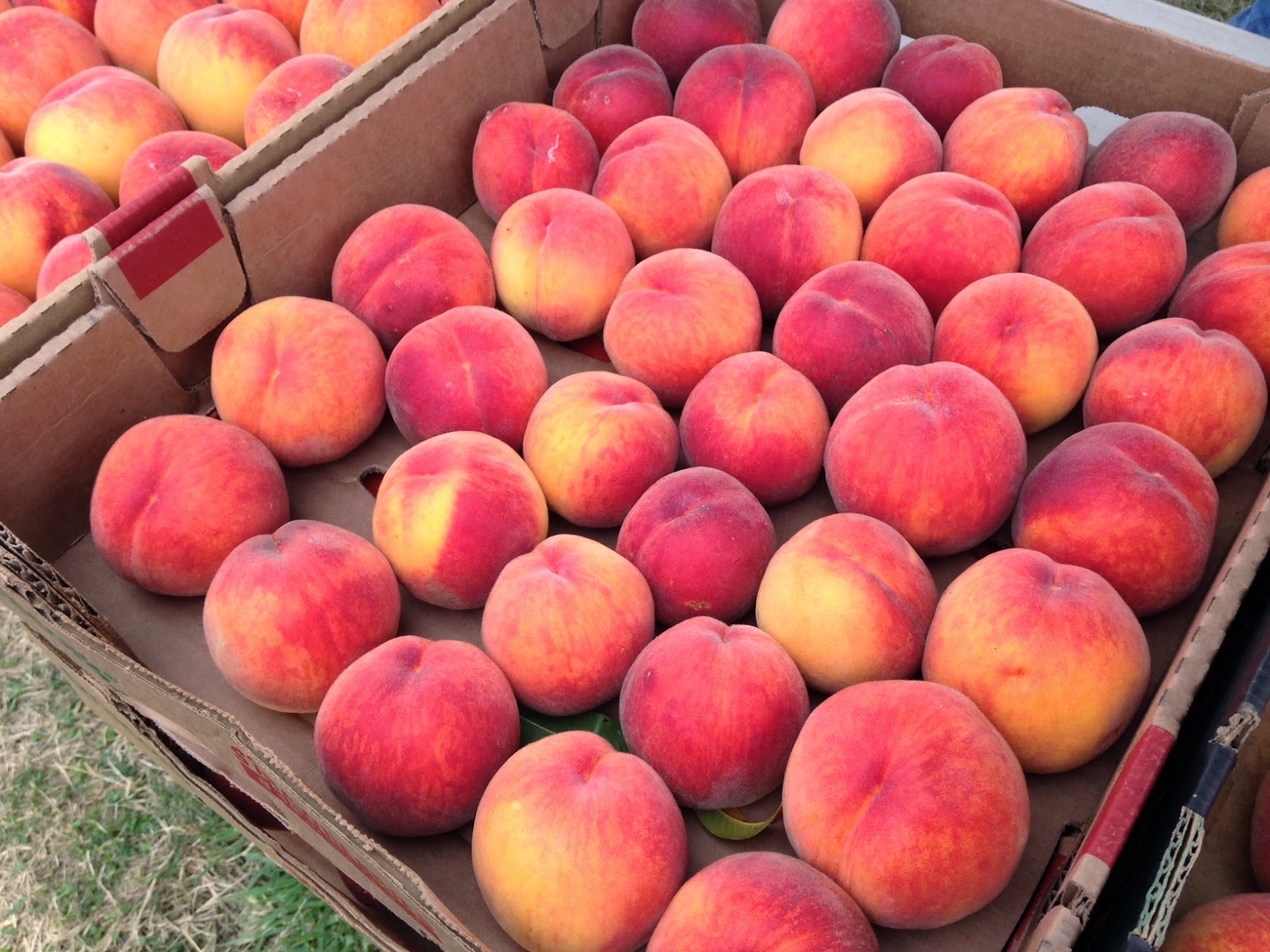
At the end of the field trip we ended up a bit chilled, wet and empty-handed. But our day was far from over. No sirree. On the way home we stopped at the Redland Store for chips and drinks. That's always a highlight of any educational field trip. Then just on the outskirts of Canby we stopped at a roadside peach stand and snagged a box of Red Haven "seconds" -- basically peaches that aren't exactly the pick of the peck, though by tasting them you'd never know it -- for $1 per lb. There is something absolutely heavenly about the aroma, color and flavor of fresh, tree-ripened peaches. Don't even bother arguing with me about it because that is the absolute truth. And lastly, we stopped at the Fred Meyer in Canby and picked up a wild sockeye salmon from Alaska for the grill. Maybe it wasn't a steelhead out of the Clackamas, but it proved to be a darn close second.

                                                 Red Haven peaches